
What is MRNAUSD? It is not a cryptocurrency called MRNA, nor is it a tokenized stock that puts Moderna shares directly into your wallet. MRNAUSD is a stock-class X-Perp derivative that tracks the price performance of Moderna Inc. (NASDAQ: MRNA). Traders gain exposure to upside or downside price movements through contract P&L—not ownership of Moderna stock.
According to market data published by AiCoin on September 1, 2026, OKX has launched MRNAUSD UM X-Perp trading. This product combines traditional U.S. equity price exposure with crypto-style 24/7 trading, leverage, funding rates, and liquidation mechanisms—offering contract traders a new way to speculate on Moderna's share price direction.
But "tradeable around the clock" does not mean lower risk. Moderna itself is a biotech company driven by event catalysts—clinical trials, regulatory decisions, product sales, and cash burn can all trigger sharp price swings. Add leverage, funding costs, basis risk, and U.S. market holidays, and MRNAUSD can carry significantly higher risk than holding ordinary shares.
Risk Disclosure: This article is for product mechanism and market research purposes only. It does not constitute investment advice, medical judgment, earnings promises, or trading recommendations. MRNAUSD is a leveraged derivative that can wipe out your entire margin in a short period. Specific trading permissions, leverage limits, funding rates, contract expiry dates, and regional restrictions are subject to the real-time rules displayed in your account.
1. What Is MRNAUSD, and Why Is Moderna Stock on OKX?
The "MRNA" in MRNAUSD comes from Moderna, Inc.'s NASDAQ ticker symbol; "USD" indicates that the contract uses U.S. dollars or eligible USD-equivalent assets for pricing and settlement.
Simply put:
MRNAUSD trades the price direction of Moderna stock—not a blockchain project named MRNA.
MRNAUSD falls under the equity X-Perp category. As per OKX's official description of TradFi X-Perps, these products track the price performance of listed stocks or other traditional assets via an index, allowing eligible users to go long or short—but they do not transfer the underlying stock to the trader.
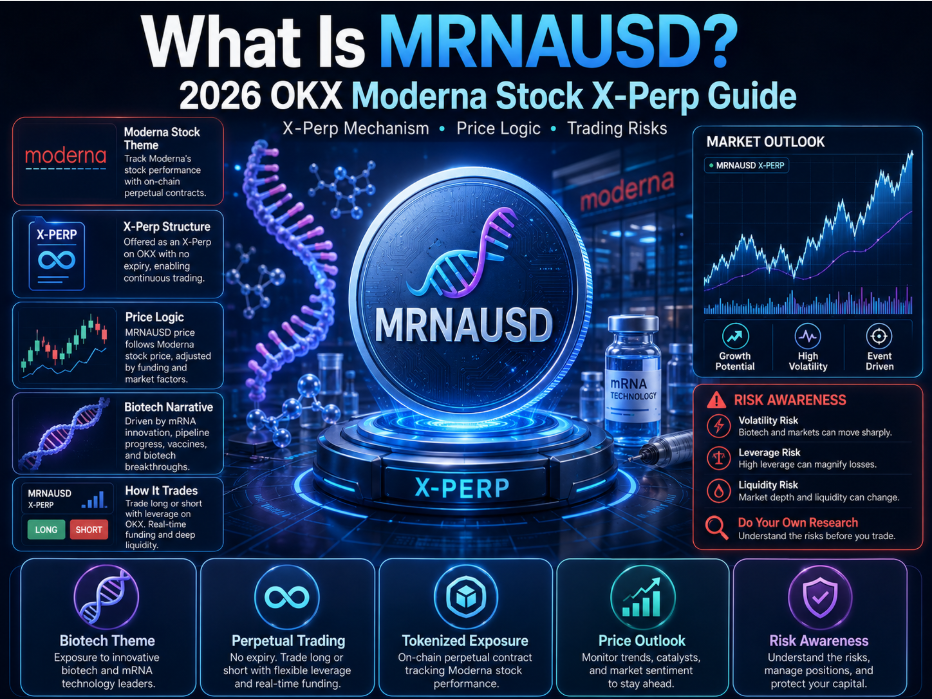
Therefore, trading MRNAUSD does not require studying token supply, unlocks, burn mechanisms, or public chain ecosystems. What you actually need to research:
- Moderna's product revenue;
- mRNA R&D pipeline;
- Clinical trial results;
- FDA and other regulatory decisions;
- Cash reserves and cash burn;
- Biotech sector valuations;
- MRNAUSD funding rates, basis, and market liquidity.
2. How Is MRNAUSD Different From Buying Moderna Stock Directly?
"Trading MRNAUSD" and "holding MRNA stock" are not the same thing.
What Do You Get When You Buy MRNA Stock?
Through a traditional brokerage account, buying MRNA stock gives you an equity stake in Moderna. Long-term value is driven by operating results—revenue, profitability, R&D progress, cash flow, product commercialization, and market valuation. Under normal market rules, shareholders may also have voting rights, corporate action entitlements, and other security-holder benefits.
What Do You Get When You Trade MRNAUSD?
An MRNAUSD position is a derivative exposure. You gain or lose based on the reference price movement of Moderna, but you also bear funding costs, margin changes, and liquidation risk.
According to OKX's X-Perps FAQ, X-Perps provide price exposure only—no underlying stock ownership. Thus, MRNAUSD traders typically do not receive:
- Shareholder status in Moderna;
- Traditional voting rights;
- MRNA shares in a brokerage account;
- Direct equity ownership or related rights;
- Cash dividends in the conventional sense.
Even though MRNAUSD prices are highly correlated with MRNA stock, the legal structure, trading venue, settlement, cost basis, and risk profile are fundamentally different.
3. Is MRNAUSD a Tokenized Version of Moderna Stock?
No. MRNAUSD X-Perp and tokenized stocks are two distinct product types.
Tokenized stocks typically provide equity economic exposure via blockchain tokens. Key areas to study:
- Token issuer;
- Underlying securities backing;
- Asset custody;
- Minting and redemption;
- Smart contracts;
- On-chain liquidity.
MRNAUSD is a derivative contract. Key areas to study:
- Reference index;
- Margin requirements;
- Leverage;
- Funding rate;
- Mark price;
- Liquidation;
- Expiry and settlement.
Both may reference Moderna's stock price, but their product structures are entirely different.
One sentence summary:
Tokenized stocks solve "how to bring equity value on-chain," while MRNAUSD solves "how to trade Moderna's price direction via contracts."
4. What Is OKX X-Perp? Why Does "Perp" Still Have an Expiry?
Crypto users often assume "Perp" means a perpetual contract with no expiry. But OKX's X-Perp is not identical to standard BTC or ETH perpetuals.
According to the OKX X-Perps Guide, X-Perps are USD-denominated forward-dated contracts that use a perpetual-like funding rate mechanism to keep prices close to the spot index, but they also have a defined future expiry date.
Currently, OKX's publicly listed equity X-Perp products typically have contract terms up to about 5 years, with new forward contracts generated near expiry to allow rollover per the applicable rules.
So a more accurate understanding is:
X-Perps offer a trading experience close to long-dated perpetuals, but structurally they are not perpetual.
Before trading MRNAUSD, always re-check the contract info page for:
- Full contract code;
- Expiry date;
- Delivery time;
- Contract face value;
- Minimum tick size;
- Settlement asset;
- Funding rate frequency;
- Current maximum leverage.
Do not assume "Perp" means the product never expires.
5. How Is MRNAUSD Different From Regular Crypto Perpetuals?
Regular crypto perpetuals track 24/7 crypto spot markets like BTC and ETH. Equity X-Perps reference traditional securities with fixed trading hours, market holidays, and corporate actions.
This means MRNAUSD must additionally handle:
- NASDAQ regular trading sessions;
- Pre-market and after-hours U.S. trading;
- Weekends and U.S. public holidays;
- Earnings reports and company announcements;
- Corporate actions like stock splits;
- Index pricing when spot is closed;
- Gap risk when stocks reopen.
Regular crypto spot markets trade continuously through weekends, while Moderna stock has no normal NASDAQ price discovery on Saturdays or Sundays. This is one of the most critical risk differences between MRNAUSD and BTC perpetuals.
6. What Drives MRNAUSD Price? Understanding the Index Price Is Lesson One
MRNAUSD's core pricing foundation remains Moderna stock, but contract trade prices do not always equal the last traded NASDAQ MRNA price at every moment.
According to OKX's explanation of stock X-Perp pricing mechanisms, the reference index may combine traditional stock quotes, data feeds from Pyth or Ondo, other market derivatives, and the platform's own contract market data.
Multiple data sources are used to reduce the impact of single-source anomalies, latency, or market disruptions.
Why Might MRNAUSD Trade at a Premium or Discount to MRNA Stock?
Possible reasons include:
- Imbalances between long and short demand;
- Changes in funding rates;
- Low liquidity in the contract market;
- Thin order book depth;
- U.S. equity markets being closed;
- Sudden clinical or regulatory news;
- Market expectations for the next U.S. open;
- Market maker risk control.
Therefore, traders should not just compare last prices on two screens. Understand these three prices:
Index Price
Reflects the aggregate market value of the underlying reference asset.
Mark Price
Used to calculate unrealized P&L and assess liquidation risk—designed to reduce the chance that a single anomalous trade triggers liquidation.
Last Price
The most recent trade price of MRNAUSD—but it may not equal the index price or mark price.
The most common beginner mistake: looking only at Last Price while not realizing liquidation risk is primarily determined by Mark Price.
7. Why Can MRNAUSD Still Trade When U.S. Markets Are Closed?
OKX equity X-Perps support extended trading windows. The relevant contract specifications show that applicable X-Perp products can be traded 24/7 until expiry, including nights, weekends, and public holidays.
When traditional stock markets are closed, traders can still use MRNAUSD to express expectations for Moderna's next opening price.
For example, if significant Moderna-related clinical news breaks on a Saturday:
- NASDAQ MRNA cannot trade normally;
- MRNAUSD may still see long/short price discovery;
- Contract prices may move up or down in advance;
- After Monday's U.S. market open, spot re-pricing occurs;
- The spread between MRNAUSD and MRNA may converge quickly or widen further.
OKX rules also state that when traditional markets are closed and real-time stock prices are unavailable, applicable products may cap real-time index fluctuations based on the last available reference price. This mechanism reduces extreme deviation but does not eliminate gap risk at reopen.
If MRNAUSD Rises Over the Weekend, Does That Guarantee MRNA Will Gap Up on Monday?
No. Weekend contract prices reflect expectations formed under limited liquidity and available information. When NASDAQ reopens, deeper equity market capital may deliver a different price.
Thus, 24/7 trading is flexibility—but it also increases:
- Slippage during low-liquidity hours;
- Incomplete price discovery;
- Widening basis;
- Monday repricing shocks;
- Leveraged position gap risk.
8. Why Might MRNAUSD Be More Volatile Than Ordinary Equity X-Perps?
Moderna is not a highly stable, broadly diversified mature tech giant. It is a biotech company whose valuation hinges on product sales, R&D pipeline, and clinical success probabilities.
Moderna's public mRNA product pipeline covers respiratory vaccines, oncology, rare diseases, and more. As programs move from early research into trials, pivotal studies, regulatory review, or commercialization, each phase can change market estimates of future revenue.
Key events that move MRNA price include:
- Phase 1, Phase 2, or Phase 3 clinical results;
- FDA and other regulatory approvals;
- Drug safety updates;
- New indications progress;
- Partnership announcements;
- Vaccine market demand;
- Quarterly earnings;
- Product revenue and gross margins;
- R&D spending;
- Cash burn rate.
A single clinical readout can simultaneously alter probability of success, future sales projections, and overall company valuation. So MRNAUSD traders face not just ordinary stock volatility—but biotech event risk.
9. Why Is the Cancer Vaccine a Potential Major Valuation Driver for MRNA?
Moderna's long-term valuation does not depend solely on respiratory vaccines. The market is also watching whether its mRNA technology can produce new commercial products in oncology, rare diseases, and other fields.
Moderna and Merck continue to advance individualized cancer therapy clinical programs. In August 2026, the companies disclosed Phase 3 progress on certain programs—information that can significantly shift investor views on Moderna's future product mix and revenue sources. Moderna's R&D updates also show oncology programs covering multiple cancer types and clinical stages.
But investors must distinguish between:
- Positive clinical results;
- Regulatory approval;
- Commercial launch;
- Physician and patient adoption;
- Commercial revenue generation;
- Ultimately, profitability.
Clinical success does not automatically equal commercial success. Drugs still face approval, manufacturing, pricing, reimbursement, competition, and market adoption risks.
For MRNAUSD traders, any major clinical date should not be treated as a routine technical event.
10. How Does the MRNAUSD Funding Rate Work?
The funding rate helps keep contract prices relatively close to the underlying index.
Per OKX's X-Perp rules, funding is calculated and settled at intervals specified for each contract. Different products may use different time periods, so always check the actual funding cycle on the trading page.
Positive Funding Rate
Typically means longs pay shorts, indicating stronger long demand.
Negative Funding Rate
Typically means shorts pay longs, possibly indicating higher short-side demand.
Why Can You Be Right on Direction but Still Have Disappointing Returns?
Suppose you are long-term bullish on Moderna, and MRNAUSD eventually rises—but you paid high funding rates throughout the holding period.
Final outcome needs to account for:
Price gain
– Funding costs
– Trading fees
– Slippage
= Net realized return
If held for a long time, cumulative funding costs can materially eat into profits.
Funding rates also help gauge crowd positioning—but they should not be used alone as a buy/sell signal. A high positive funding rate suggests long crowding, but does not guarantee an immediate drop; a negative rate does not mean a bounce is imminent.
11. Leverage Magnifies More Than Just Gains
Leverage allows you to control a larger notional position with less margin.
For example, with 5× leverage, a 2% adverse move in the underlying can cause 10% P&L change on your position—before considering funding, fees, and margin rules.
Higher leverage means:
- Less tolerance for adverse moves;
- Liquidation price closer to entry;
- Greater damage from sudden events;
- Less time to adjust positions.
Actual P&L also depends on contract face value, margin mode, and fees—do not treat simple multiplier examples as precise settlement formulas.
Why Is High Leverage Particularly Unsuitable for Moderna?
Because Moderna is prone to sudden moves driven by clinical results, FDA news, safety data, earnings, and partnership announcements.
Even if your long-term thesis is correct, a short-term adverse move can liquidate your highly leveraged position. Later, if regulatory progress improves and the stock rallies, the liquidated position cannot be automatically restored.
That is the difference between "being right on direction" and "succeeding in trading."
12. Why Does MRNAUSD Rise? Seven Categories of Indicators to Track
Moderna Clinical Trial Data
Clinical data changes probability of success—the single most important event variable for MRNA.
Also examine:
- Trial phase;
- Whether primary endpoints were met;
- Safety data;
- Sample size;
- Difference from control group;
- Subsequent regulatory pathway.
Do not trade solely based on headline words like "positive" or "breakthrough."
FDA and Other Regulatory Decisions
Approval, rejection, delay, additional data requests, or safety reviews directly impact product launch timing and revenue expectations.
Product Sales Revenue
Clinical narratives must eventually convert to commercial revenue. Track sales volume, pricing, market share, seasonality, and gross margins.
R&D Pipeline Value
Beyond commercialized products, assess the stage, probability of success, and total addressable market for respiratory, oncology, and rare disease programs.
Cash Reserves and Cash Burn
Biotechs require sustained R&D, clinical, and manufacturing investment. Even promising pipelines can face program cuts, financing needs, or dilution if cash burn is too rapid.
Regularly check Moderna's quarterly results page for updated cash balances, revenue, R&D spending, and company guidance.
Biotech Sector Risk Appetite
Falling interest rates may improve valuation environments for long-duration growth names, but macro liquidity cannot substitute for drug development outcomes.
MRNAUSD Contract Data
Even if MRNA stock moves little, MRNAUSD can show short-term swings due to leveraged capital flows.
Key metrics:
- Funding rate;
- Open interest;
- 24h volume;
- Long/short position changes;
- Basis;
- Bid-ask spread;
- Market depth.
13. How Should You Approach MRNAUSD Price Forecasting?
Avoid guessing "Will MRNAUSD hit $200 by year-end?" A more rational approach uses a two-layer model.
Layer 1: Estimate Moderna's Fundamental Value
Research:
- Product revenue;
- R&D pipeline;
- Clinical success probabilities;
- Regulatory progress;
- Cash reserves;
- Cash burn;
- New product commercialization capacity;
- Biotech sector valuations.
Layer 2: Analyze X-Perp Market Conditions
Then observe:
- Index price;
- Mark price;
- Funding rate;
- Basis;
- Open interest;
- Long/short crowding;
- Liquidity;
- Whether U.S. markets are closed.
The final MRNAUSD price logic can be summarized as:
Moderna fundamental valuation
+ Equity market risk appetite
+ X-Perp premium or discount
= MRNAUSD trading price
Bullish Scenario
May require simultaneous:
- Positive key clinical readouts;
- Smooth FDA progress;
- Improving commercial adoption;
- Revenue growth;
- Controlled cash burn;
- Biotech sector valuation recovery;
- Adequate MRNAUSD liquidity with reasonable basis.
Neutral Scenario
Could feature:
- Pipeline advancing normally;
- Relatively stable product revenue;
- Cash burn in line with guidance;
- Market waiting for the next major catalyst;
- Range-bound movement for both MRNA and MRNAUSD.
Bearish Scenario
Might include:
- Key clinical trial failure;
- Regulatory delay or rejection;
- Drug safety concerns;
- Below-expected product sales;
- Accelerating cash burn;
- Biotech multiple contraction;
- Overcrowded long leverage in MRNAUSD.
Price forecasts should be treated as scenario analysis, not earnings guarantees.
14. How Does MRNAUSD Compare to BABAON?
An analysis of what BABAON is describes Alibaba tokenized stock assets, focusing on how equity economic value is brought on-chain via RWA structures.
For BABAON, study:
- Alibaba stock fundamentals;
- Token issuance structure;
- Underlying asset backing;
- Custody and redemption;
- On-chain liquidity;
- Premiums and discounts.
MRNAUSD is a derivative contract—focus on:
- Moderna reference price;
- Funding rate;
- Leverage;
- Margin;
- Index price;
- Mark price;
- Liquidation.
The core distinction:
BABAON is about "how a stock is tokenized"; MRNAUSD is about "how a stock price is turned into a leveraged derivative."
Even if both trade in crypto environments, do not apply the same valuation and risk analysis methods.
15. How Does MRNAUSD Differ From BLUECHIP?
The asset described in what BLUECHIP is leans toward Base ecosystem memes, AI chip narratives, and stock-related stories—its price may heavily depend on community virality, attention, and meme hype.
MRNAUSD has a clear stock reference. Its core risks come from:
- Moderna company fundamentals;
- U.S. equity markets;
- Biotech events;
- Derivative mechanisms;
- Leverage and liquidation.
Thus:
- BLUECHIP carries more narrative risk;
- MRNAUSD carries more equity risk, event risk, and derivatives risk.
A name resembling a stock or tech theme does not mean the asset itself is a stock derivative. For any new asset, always verify its legal and product structure first.
16. Why Should MRNAUSD Traders Still Watch BTC, ETH, and BNB?
MRNAUSD's ultimate pricing source is Moderna, not crypto markets. But since it trades on a crypto platform, overall platform liquidity and risk appetite can still affect contract trading.
BTC Reflects Overall Crypto Risk Appetite
Traders can gauge whether crypto is entering a rapid de-leveraging phase via BTC price analysis. When BTC drops sharply, you may see:
- Increased margin pressure;
- Users actively reducing leverage;
- Lower contract market liquidity;
- Synchronized selling of risk assets.
These factors can amplify short-term MRNAUSD volatility—but they do not change Moderna's clinical results or revenue.
ETH Reflects On-Chain Finance and RWA Sentiment
ETH price forecasts can help monitor sentiment around DeFi, RWA, and tokenized stocks. ETH rising does not mean Moderna's profitability improves—it is just a crypto market environment variable.
BNB Reflects Liquidity of Major Crypto Assets
BNB real-time price and BNB forecasts can serve as auxiliary indicators for crypto risk appetite.
Always remember:
BTC, ETH, and BNB mainly affect MRNAUSD's trading-side sentiment; Moderna's fundamentals remain the core long-term pricing driver.
17. MRNAUSD Trading Strategy: Emphasize Event Risk Management
Reduce Leverage Ahead of Major Clinical Events
FDA decisions or Phase 3 readouts are not ordinary K-line events. After release, gaps can occur—and stop-loss orders may not fill at your preset price.
If you cannot tolerate the uncertainty, the prudent choice is to reduce position size, lower leverage, or wait for the event to pass.
Do Not Rely Solely on MRNAUSD Charts
Before trading, also review:
- NASDAQ MRNA price action;
- Moderna investor relations page;
- SEC filings;
- FDA updates;
- Clinical trial calendars;
- MRNAUSD funding and OI.
Analyzing only the contract K-line misses the corporate events that truly drive the stock.
Monitor Basis Before and After U.S. Market Opens
After weekends, holidays, or major news, compare:
- MRNAUSD last price;
- Index price;
- Mark price;
- Latest available MRNA stock reference;
- Price after U.S. reopen.
When basis widens rapidly, do not assume the contract price is always correct—nor blindly bet that the spot will converge.
Use Funding to Gauge Crowding
Funding reflects long/short dynamics but should not be a standalone entry signal.
High positive funding may mean rising carry costs for longs; extreme negative funding may indicate crowded shorts. Either way, combine with price, OI, volume, and fundamental catalysts.
Start Small Before Going Big
For event-driven biotech stocks, position sizing often matters more than pinpointing the perfect entry.
Your trading plan should at least specify:
- Maximum position size;
- Maximum leverage;
- Maximum acceptable loss;
- Whether to reduce before clinical events;
- Funding cost cap;
- Distance to liquidation price;
- Exit conditions.
18. The Nine Biggest Risks of MRNAUSD
Leverage Risk
Leverage amplifies both gains and losses. A small adverse move in the underlying can cause significant margin loss.
Liquidation Risk
When margin falls below maintenance requirements, the system may automatically reduce or liquidate positions. Once liquidated, even if price recovers, the position does not come back.
Biotech Event Risk
Clinical trials, drug safety, regulatory approvals, and partnerships can cause price gaps.
U.S. Market Holiday Risk
MRNAUSD can still trade, but NASDAQ spot lacks normal price discovery on weekends and holidays, leading to potential gaps at reopen.
Basis Risk
MRNAUSD is not guaranteed to trade precisely in line with MRNA stock at all times. Demand imbalances, liquidity, and funding can create deviations.
Funding Cost Risk
Holding long-term may incur ongoing funding payments. Even with correct directional view, net returns can be eroded by fees.
Liquidity Risk
New contracts may have thin order books, wide spreads, and higher slippage on market orders.
Index vs. Trade Price Discrepancy
Last Price, Mark Price, and Index Price serve different purposes. Misunderstanding them can lead to misjudging P&L and liquidation risk.
Product and Regional Restrictions
OKX explicitly notes that X-Perps are not available in all regions or for all clients. Always check the product permissions, contract specifications, and local rules shown in your logged-in account—do not attempt to circumvent regional restrictions to trade.
19. Who Is MRNAUSD Suitable For?
MRNAUSD is more appropriate for traders who already understand:
- Moderna company fundamentals;
- Biotech clinical event risk;
- Futures or contract mechanics;
- Funding rates;
- Mark price;
- Margin and liquidation;
- U.S. market hours and holiday schedules.
It is less suitable for:
- Those who mistake MRNA for a new cryptocurrency;
- Those with no knowledge of Moderna;
- Those who only open positions based on gainers lists;
- Those who cannot grasp funding rates;
- Those relying on high leverage for quick profits;
- Those unable to tolerate event-driven gaps.
MRNAUSD lowers the access barrier to trading Moderna's price direction—but it does not lower the risks inherent to Moderna itself or to leveraged derivatives.
20. What to Check Before Trading MRNAUSD
After searching for MRNAUSD on OKX, do not place an order immediately. At a minimum, check:
- Whether you have trading permissions for this product;
- Full contract name and expiry date;
- Latest MRNA stock price;
- Index Price, Mark Price, and Last Price;
- Current funding rate and settlement schedule;
- Open interest and 24h volume;
- Bid-ask spread and order book depth;
- Current leverage and margin mode;
- Estimated liquidation price;
- Upcoming Moderna earnings, clinical, and FDA calendar events;
- Whether U.S. markets are currently open or closed.
Limit orders improve price control but do not guarantee execution; market orders fill faster but may incur significant slippage in low liquidity.
Beginners should not interpret "maximum leverage allowed by the platform" as "leverage suitable for them."
21. Frequently Asked Questions About MRNAUSD
What is MRNAUSD?
MRNAUSD is a stock-class X-Perp derivative that tracks Moderna's stock price performance—not a crypto-native token.
Is MRNAUSD the same as Moderna stock?
No. Traders hold a derivative position, not MRNA shares in a traditional brokerage account.
Is MRNAUSD a cryptocurrency?
It trades on a crypto platform, but it is essentially a stock-price-linked derivative, not a cryptocurrency running on blockchain tokenomics.
What is the difference between MRNAUSD and MRNA stock?
MRNA is a NASDAQ-listed equity; MRNAUSD is a contract that tracks its price. They differ in ownership, shareholder rights, trading hours, leverage, and risk.
Is X-Perp a perpetual contract?
Not exactly. OKX X-Perps use a funding rate mechanism but have forward expiry dates—always check the specific contract terms.
Does MRNAUSD have an expiry?
Yes, X-Perps are dated products. Verify the specific expiry date on the MRNAUSD contract info page.
Can MRNAUSD be traded 24/7?
Applicable OKX equity X-Perps support 24/7 trading until expiry, subject to regional permissions and maintenance schedules as shown in your account.
Can I trade MRNAUSD on weekends?
If product permissions and market status allow, X-Perps can trade on weekends. However, there is no normal NASDAQ spot price discovery on weekends, so basis and reopen risks are higher.
Why does MRNAUSD trade at a different price from MRNA stock?
Possible reasons: funding rates, long/short demand, liquidity, U.S. market closures, and market expectations.
Does MRNAUSD have a funding rate?
Yes. The funding rate helps keep contract prices close to the reference index—traders may pay or receive funding.
Does MRNAUSD pay dividends?
Trading MRNAUSD is not holding Moderna stock, so you generally do not receive shareholder dividends or voting rights.
Can I use leverage on MRNAUSD?
X-Perps are leveraged derivatives. Actual available leverage depends on region, account eligibility, position size, and platform rules in real time.
Can MRNAUSD be liquidated?
Yes. If margin falls below maintenance requirements, positions may be reduced or liquidated.
Why does Moderna stock rise?
Possible catalysts: clinical trial results, regulatory approvals, product sales, pipeline updates, earnings, cash position, and biotech sector valuation trends.
Is MRNAUSD worth trading?
Do not judge solely by Moderna's long-term story. Also evaluate event risk, leverage, funding, basis, liquidity, and your personal risk tolerance.
What is the difference between MRNAUSD and tokenized stocks?
Tokenized stocks provide equity economic exposure via tokens; MRNAUSD is a derivative contract with margin, funding, and liquidation mechanisms.
22. Conclusion: Trading MRNAUSD Is Essentially Trading Three Layers of Risk Simultaneously
MRNAUSD is not "a more convenient way to own Moderna." It is a trading tool that combines Moderna's equity price risk with crypto derivative mechanics.
Analyzing MRNAUSD requires understanding three distinct layers of risk.
Layer 1 – Moderna Company Risk: Product sales, clinical trials, regulatory approvals, R&D pipeline, and cash burn.
Layer 2 – Equity Market Risk: NASDAQ pricing, biotech valuations, interest rates, and market risk appetite.
Layer 3 – X-Perp Derivative Risk: Leverage, funding, liquidation, basis, expiry, and 24/7 trading.
Only by understanding all three layers can traders avoid mistaking MRNAUSD for a common crypto token—or misinterpreting 24-hour trading as lower risk.
Ultimately, MRNAUSD's medium- and long-term direction is driven by Moderna's products and R&D value. Whether a trader preserves their capital depends on margin, leverage, funding costs, and event risk management.
Thus, the research sequence should be:
Study Moderna first
→ Then assess MRNA stock value
→ Then analyze X-Perp index, funding, and basis
→ Finally decide whether to open an MRNAUSD position
Not: spot MRNAUSD on a leaderboard, enter with maximum leverage, then search for reasons why it should keep rising.