
What exactly is BLUECHIP? Is it a blue-chip asset in the traditional financial sense, or a tokenized product linked to NVIDIA stock? Why would a meme token simultaneously invoke Base, AI chips, NVDA, and the concept of "Blue Chip"?
These questions determine how investors should understand BLUECHIP.
According to publicly available materials from trading platforms, BLUECHIP (BLUE CHIP) is classified as a Meme Token. The project builds its market narrative around the Base ecosystem, AI semiconductors, NVIDIA-related tokenized assets, and the traditional finance concept of "Blue Chip."
It is not an official token issued by NVIDIA, does not represent NVIDIA stock, and is not a blue-chip asset valued through traditional cash flows, profits, or P/E ratios.
What makes BLUECHIP genuinely distinctive is that it combines four elements that easily capture market attention:
- Base's blue branding and meme ecosystem;
- AI chip and semiconductor hype;
- NVIDIA and NVDA-related narratives;
- Tokenized stocks and traditional finance blue-chip culture.
This combination gives BLUECHIP more angles for virality than the average animal meme, but it also makes it easier for newcomers to mistakenly assume a direct equivalence to NVIDIA equity, blue-chip stocks, or RWA.
Therefore, researching BLUECHIP requires more than asking "does the story sound good?" — you also need to assess:
- Whether Base still has fresh capital inflows;
- Whether AI chips remain a hot topic in crypto markets;
- Whether the narrative linking BLUECHIP to NVDA-related assets can persist;
- Whether trading volume, holder counts, and liquidity are growing in sync;
- Whether the current market cap has already priced in future attention;
- Whether contract, network, and whale concentration risks exist.
Risk Disclaimer: This article is for project information organization, market research, and investment education only. It does not constitute investment advice, performance guarantees, or trading recommendations. BLUECHIP is a high-volatility meme asset; prices may experience sharp drawdowns due to narrative cooling, declining liquidity, whale selling, or shifts in market risk appetite. Before depositing or withdrawing, always refer to the real-time network and contract address displayed on your trading platform.
1. What is BLUECHIP? Why Does "Blue Chip" Become a Base Meme?
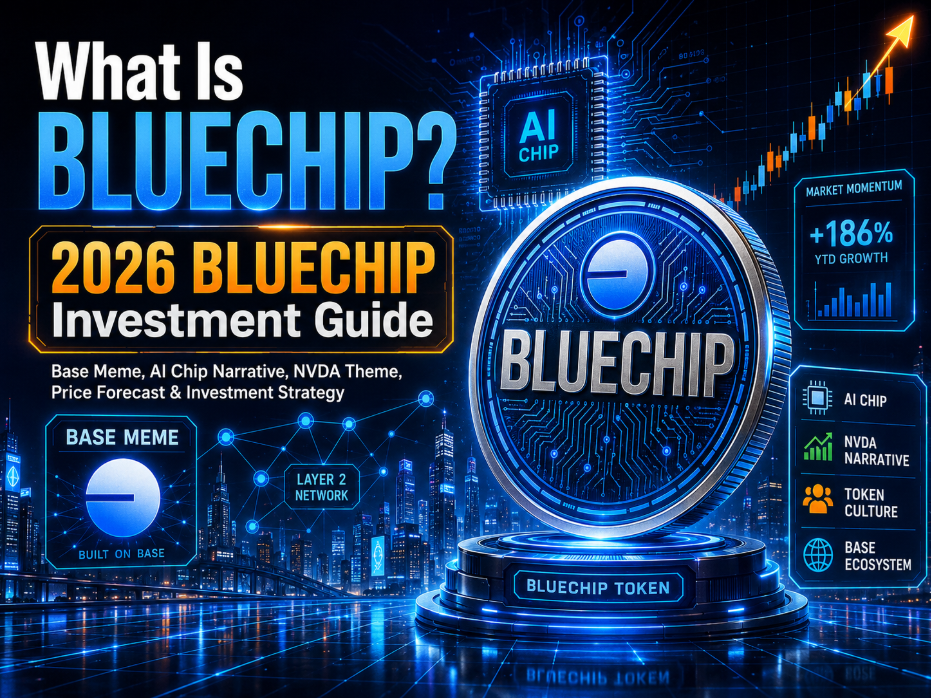
BLUECHIP is a Meme Token built around a double entendre of "Blue Chip," Base's blue branding, AI semiconductors, and NVIDIA-related market narratives.
In its listing materials, LBank tags BLUECHIP as MEME and describes it as a project combining Base, AI chips, and traditional finance "Blue Chip" concepts.
Investors can check BLUECHIP Real-Time Price & BLUECHIP/USDT Market for the latest quotes, 24h change, volume, and trend.
But a price page only tells you the current trading price — it does not prove that BLUECHIP has blue-chip cash flows, NVIDIA equity value, or asset backing from tokenized stocks.
Is BLUECHIP a Blue-Chip Asset?
No.
In traditional finance, "Blue Chip" typically refers to large-cap, industry-leading companies with relatively stable earnings and long operating histories.
When analyzing traditional blue-chip stocks, investors may look at:
- Revenue;
- Net income;
- Free cash flow;
- Dividends;
- Market share;
- Balance sheets;
- Corporate governance;
- Long-term competitiveness.
BLUECHIP Token, at present, is much closer to a high-risk meme asset. Its price is primarily driven by narrative, attention, community, liquidity, and market risk appetite.
Thus:
Calling it BLUECHIP does not make it a low-risk blue-chip asset.
For newcomers, this may be the most critical risk insight in this entire article.
Why Does "Blue Chip" Form a Double Entendre?
The name BLUECHIP points to two distinct concepts at once.
First, the traditional finance "Blue Chip" — blue-chip stocks.
Second, the literal "blue chip" — a blue-colored semiconductor chip.
Combined with Base's blue-dominant brand identity, the project creates a narrative that is easy to spread:
- Base represents the blue ecosystem;
- Chip represents AI semiconductors;
- NVIDIA represents the AI chip megatrend;
- Blue Chip evokes traditional finance and stock assets.
This is what differentiates BLUECHIP from ordinary animal memes. Its virality doesn't rely on a single image — it borrows from crypto, AI, and TradFi cultures simultaneously.
Is BLUECHIP a Meme or RWA?
Based on current public classification and value logic, BLUECHIP is first and foremost a Meme Token.
Its narrative or liquidity ties to NVIDIA-related tokenized assets do not mean BLUECHIP itself is a NVIDIA Tokenized Stock, nor that each BLUECHIP token is backed by corresponding NVDA shares.
A more accurate classification is:
BLUECHIP is a meme asset that leverages AI chips, NVDA, and tokenized-stock concepts for its narrative — not an RWA strictly pegged to NVIDIA stock value.
2. What Is the Relationship Between BLUECHIP and NVIDIA?
The relationship is primarily narrative-based, not equity-based.
Investors must distinguish between four concepts:
- NVIDIA is a public company;
- NVDA is NVIDIA's stock ticker;
- NVDA-related Tokenized Stocks are stock-tokenized products;
- BLUECHIP is a Meme Token that uses NVIDIA and AI chip narratives for distribution.
These four are not interchangeable.
Is BLUECHIP an Official NVIDIA Token?
No.
There is no evidence that BLUECHIP is issued by NVIDIA, nor should it be called an official NVIDIA cryptocurrency.
Holding BLUECHIP typically does not entitle you to:
- NVIDIA equity;
- NVIDIA dividends;
- NVIDIA voting rights;
- NVIDIA corporate assets;
- NVIDIA profit distributions;
- NVDA stock redemption rights.
The project using NVIDIA, NVDA, or AI chip narratives does not equal an endorsement from NVIDIA.
Why Does BLUECHIP Form a Trading Relationship with NVDAc?
Public project descriptions mention that BLUECHIP forms a direct trading pair with NVDA-related assets on Base.
On traditional DEXs, meme tokens usually pair with ETH, USDC, or other major assets.
BLUECHIP's choice to establish trading or liquidity links with NVIDIA-related tokenized assets further reinforces:
AI Chip Meme × Tokenized Equity.
This design boosts the project's narrative distinctiveness and allows BLUECHIP to enter discussions around both memes and RWA.
However, a trading pair only means two assets can be exchanged — it does not prove a fixed economic peg between their values.
If NVDA Rises, Will BLUECHIP Definitely Rise?
Not necessarily.
A possible transmission path could be:
NVDA rises → increases market attention on NVIDIA and AI chips → NVDA-related tokenized assets see more searches and trading → BLUECHIP's AI chip narrative strengthens → speculative capital further focuses on BLUECHIP.
But every step in this chain is non-deterministic.
If NVDA rises but BLUECHIP's community activity drops, volume shrinks, or whales sell, BLUECHIP can still fall.
Conversely, BLUECHIP might rally without any significant NVDA move, driven by a Base meme run, exchange listings, or short-term capital flows.
Thus:
NVDA is an important Narrative Variable for BLUECHIP, not a strict price anchor.
3. Why Did BLUECHIP Choose Base?
Base is a Coinbase-affiliated Ethereum Layer 2 ecosystem designed to provide lower-cost, higher-efficiency on-chain transactions.
For BLUECHIP, Base is not just a deployment and trading network — it's also a key component of the project's brand narrative.
Why Does Base Attract Meme Projects?
Meme projects typically need:
- Low transaction costs;
- Active DEXs;
- Easy liquidity creation;
- Sufficient wallet users;
- Social media attention;
- Ecosystem trends;
- Demand for new asset trading.
Base benefits from the Coinbase brand association, Ethereum ecosystem compatibility, and growing on-chain applications, making it attractive for new meme tokens.
But launching on Base does not mean Coinbase endorsement, nor does it guarantee a listing on the Coinbase exchange.
Why Does Base's Blue Brand Fit BLUECHIP?
BLUECHIP's narrative heavily relies on "blue."
Base's blue visual identity, the traditional finance meaning of Blue Chip, the semiconductor chip, and NVIDIA-related AI themes create a unified brand language:
Base Blue + AI Chip + Blue-Chip Stocks + Meme Culture.
This narrative is simple, easy to visualize, and spreads well on X, Telegram, and other communities. For a meme token, being able to tell the story in ten seconds is critical.
How Does Base Ecosystem Heat Affect BLUECHIP?
BLUECHIP can be viewed as an asset with some "Base Beta" characteristics.
When Base on-chain activity, DEX volume, and meme trading increase, more capital may seek out new projects with strong narratives, and BLUECHIP may gain additional attention.
Investors can monitor:
- Base active addresses;
- DEX trading volume;
- Stablecoins and bridged funds;
- Meme token trading volumes;
- New wallet creation;
- Coinbase ecosystem trends;
- Social media discussion volume.
However, Base growing does not guarantee BLUECHIP rises. BLUECHIP still needs its own community, volume, liquidity, and holder growth to sustain price.
4. BLUECHIP's Four Core Narrative Layers
BLUECHIP has no traditional company revenue or profits, so market narrative plays a critical role in price action.
Meme Culture
The name "Blue Chip" is easy to grasp and carries a sense of irony.
Traditional blue-chip stocks represent stability and maturity, while BLUECHIP as a meme token is highly volatile and speculative. This contrast itself becomes shareable content.
AI Chips
"Chip" naturally connects to:
- NVIDIA;
- Broadcom;
- ARM;
- GPU;
- AI servers;
- Data centers;
- Semiconductors;
- AI compute.
When the AI hardware narrative heats up, BLUECHIP may regain discussion mindshare. However, it does not directly own revenue or equity in these companies.
NVIDIA & NVDA
NVIDIA is one of the most iconic public companies in AI infrastructure.
When the market discusses Blackwell, GPUs, AI CapEx, and data centers, BLUECHIP can leverage the NVDA narrative for attention. This is Narrative Exposure, not Equity Exposure.
Tokenized Stocks & RWA
BLUECHIP's trading or liquidity relationships with NVDA-related assets allow it to enter discussions around tokenized stocks and RWA. This structure gives it more financial-culture elements than a pure animal meme.
But investors must remember:
Having a trading pair with RWA does not mean BLUECHIP itself is backed by real stocks.
5. Why Did BLUECHIP Rise? Six Factors Behind the Rally
More Exchange Listings
Exchange listings can potentially bring:
- Expanded user reach;
- Increased market exposure;
- Higher search volume;
- Improved liquidity;
- Short-term capital inflows;
- Cross-exchange arbitrage.
HiBT already offers BLUECHIP/USDT trading. Support from other platforms may further expand market access. But listings are catalysts — they do not prove long-term value.
Base Meme Season Heating Up
If capital concentrates into Base ecosystem meme assets, BLUECHIP may benefit from sector beta. However, meme seasons are often short-lived, and capital can rotate quickly to other chains or themes.
NVIDIA & AI Chips Becoming a Hot Topic Again
NVIDIA earnings, GPU demand, AI capital expenditure, and data center builds can all elevate AI chip discussion. BLUECHIP gains narrative exposure from this, but the impact is transmitted through market sentiment, not corporate profits.
Tokenized Stock Market Heating Up
If markets focus heavily on tokenized stocks like NVDA, ARM, and AVGO, BLUECHIP — as a "tokenized-equity × meme" asset — may attract extra attention.
Community Growth & Social Volume
Meme asset prices are highly dependent on attention.
Recommended metrics to track:
- X mentions;
- Telegram activity;
- Community member growth;
- KOL posts;
- Meme image count;
- Search trends;
- Watchlist additions;
- Exchange internal search volume.
Rising social heat alone does not guarantee price increases, but sustained declines in attention typically weaken meme asset liquidity and fresh demand.
BTC & ETH Market Environment
BTC generally affects risk appetite across crypto markets. Investors may reference BTC Price Prediction & Market Cycles to gauge whether markets are in a Risk-On phase.
ETH has a more direct relationship with Ethereum and its Layer 2 ecosystem. ETH Price Prediction & Ethereum Trends can also help assess Base-related capital conditions.
When BTC and ETH are strong, capital may flow further into small-cap memes. When BTC drops sharply or deleveraging occurs, high-risk assets like BLUECHIP typically see larger retracements.
6. How to Read BLUECHIP Price Predictions
Investors can check BLUECHIP Price Prediction & Market Trends for multi-timeframe movements.
But for meme tokens, fixed price targets are generally low-reliability.
BLUECHIP Cannot Be Valued with P/E
Tokens like BABAON, XAVGO, XAAOI, and XARM have underlying real companies with observable revenue, profits, and free cash flow.
BLUECHIP itself has no such corporate cash flows, so you cannot use:
- P/E;
- EPS;
- EBITDA;
- Free Cash Flow Yield;
- Dividend yield.
A more suitable framework for BLUECHIP is:
Narrative + Liquidity + Market Cap + Volume + Community.
Why Market Cap Matters More Than Per-Token Price
A low per-token price does not mean the project is cheap. Market cap must consider token supply:
Token Price × Circulating Supply = Circulating Market Cap.
If supply is very large, even a $0.01 price may correspond to a high valuation.
Investors should also check:
- Total supply;
- Circulating supply;
- Burn addresses;
- Liquidity pools;
- Team or affiliated addresses;
- Whale concentration;
- Whether new supply can be minted.
Optimistic Scenario
An optimistic scenario may require simultaneous:
- Base meme heat rising;
- AI chips remaining hot;
- NVIDIA maintaining high attention;
- Tokenized stocks becoming a crypto hotspot;
- More exchange listings;
- Trading volume growing rapidly;
- Holder addresses increasing;
- Liquidity improving;
- Community spread expanding;
- BTC and ETH in a Risk-On environment.
Under these conditions, BLUECHIP may achieve a higher valuation, but sharp pullbacks remain likely along the way.
Neutral Scenario
A neutral scenario may include:
- Base ecosystem remaining active;
- BLUECHIP community sustaining baseline attention;
- AI narrative not cooling significantly;
- Volume holding but not growing quickly;
- Fewer new exchange catalysts.
In this case, price may enter high-volatility consolidation.
Pessimistic Scenario
A pessimistic scenario includes:
- Meme hotspots rotating away;
- Base trading activity declining;
- AI chip narrative cooling;
- Tokenized stock interest fading;
- BLUECHIP volume contracting;
- New holder growth stalling;
- Large wallets selling concentrated amounts;
- Liquidity pools shrinking;
- BTC entering Risk-Off.
If attention and liquidity both weaken, BLUECHIP could see very large drawdowns.
7. What's the Difference Between BLUECHIP and XAVGO, XAAOI, XARM?
Although these assets can all be grouped under "AI chip" themes, their underlying value is completely different.
BLUECHIP: AI Chip Meme Narrative
BLUECHIP relies primarily on:
- Sentiment;
- Meme culture;
- The Base ecosystem;
- NVIDIA storytelling;
- Community spread;
- Market liquidity.
Its investment logic is closer to attention trading.
XAVGO: Broadcom Company Fundamentals
Learn what XAVGO is — XAVGO revolves around Broadcom's real business, including:
- AI ASICs;
- Google TPU;
- Custom XPUs;
- AI networking;
- VMware;
- Free cash flow.
XAVGO ultimately depends on Broadcom's revenue, profits, and valuation.
XAAOI: AI High-Speed Optical Communications
Learn what XAAOI is — XAAOI focuses on:
- 800G;
- 1.6T;
- Optical modules;
- Hyperscaler orders;
- AI data centers;
- Capacity and gross margins.
XAAOI is backed by Applied Optoelectronics' company fundamentals.
XARM: CPU Architecture & Semiconductor IP
Learn what XARM is — XARM covers:
- ARM architecture;
- CPUs;
- Licensing revenue;
- Royalty revenue;
- AI servers;
- PC and Edge AI;
- Semiconductor IP.
The Most Important Difference
XAVGO, XAAOI, and XARM provide economic exposure to real public companies.
BLUECHIP provides narrative exposure to AI chips, NVIDIA, and Base — formed as a meme.
Therefore, even with the "AI chip" label, the analytical approach is entirely different.
8. BLUECHIP Investment Strategy: Treat It as a High-Risk Narrative Position
BLUECHIP should not be treated as a core asset on par with BTC, ETH, or stablecoins.
A more suitable positioning is:
Narrative Position / Speculative Position.
Wait for Volume Confirmation
A price rise accompanied by increasing volume generally indicates broader market participation compared to a volumeless pump. However, volume can also come from short-term flipping, market-making, or bots — so combine with holder and liquidity data.
Watch for a Second Leg After a Pullback
Meme token first-leg rallies often come with extreme euphoria.
Consider this pattern:
- Initial rise;
- Price pulls back;
- Volume declines;
- Chips are redistributed;
- Then price breaks out again with renewed volume.
If the second leg also shows increases in volume, holders, and liquidity, the structure may be healthier than a single spike. But no technical pattern guarantees continuation.
Scale In Rather Than Go All-In at Once
For example, a planned position could be split as:
- 20% initial observation;
- 30% after trend confirmation;
- 30% after a volume-confirmed breakout;
- Remaining 20% as risk reserve.
This is a risk-management illustration, not a fixed ratio for all investors.
If narrative, liquidity, or contract security issues arise, do not mechanically add.
Plan an Exit Strategy in Advance
One of the most common pitfalls in meme coins is not having a take-profit plan, letting all paper gains evaporate.
Pre-define:
- Reduce a portion at the first target;
- Reduce more at the second target;
- Manage the remainder based on trend;
- Exit if the logical thesis breaks;
- Re-evaluate if volume and liquidity decline.
Exit decisions should be based on price, volume, liquidity, and narrative changes — not momentary emotion.
Do Not Use Excessive Leverage You Cannot Afford
Some platforms offer BLUECHIP perpetual contracts and leveraged trading.
BLUECHIP itself is already highly volatile; adding high leverage significantly increases liquidation risk.
High-volatility meme + high leverage is a dangerous combination for newcomers.
9. What Data Should BLUECHIP Holders Monitor Daily?
Price & 24h Change
Track current price levels via BLUECHIP Real-Time Price & Market Data.
24-Hour Trading Volume
Assess whether price moves are supported by trading participation.
Circulating Market Cap
Don't just look at the per-token price.
DEX & CEX Liquidity
Check how much slippage large orders may cause.
Holder Addresses
Growing holder counts may indicate expanding user base, but one user can control multiple wallets — holder numbers alone do not prove real adoption.
Top Holder Concentration
Distinguish between:
- Exchange addresses;
- Liquidity pools;
- Team or affiliated addresses;
- Ordinary whales;
- Burn addresses;
- Cross-chain addresses.
A superficially distributed address list does not guarantee actual control is dispersed.
Base On-Chain Activity
Monitor Base DEX volume, active addresses, bridged funds, and meme market performance.
NVIDIA & AI Chip News
NVIDIA earnings, GPU demand, and AI CapEx can affect BLUECHIP's narrative heat.
Social Media Sentiment
Attention changes for meme tokens often lead volume and liquidity shifts.
10. What Are the Biggest Risks of BLUECHIP?
Lack of Traditional Cash Flow Support
BLUECHIP has no comparable revenue, profit, or cash-flow valuation basis. Its price depends mainly on what the market is willing to pay.
NVIDIA Narrative ≠ NVIDIA Value
Even if NVDA rises, BLUECHIP may not. BLUECHIP does not own NVIDIA equity or profits.
Meme Hotspot Rotation
Market attention can shift quickly from AI memes to:
- Prediction markets;
- DeFi;
- RWA;
- New L1s;
- Other chain memes;
- Other cultural themes.
After attention rotates, BLUECHIP volume may drop sharply.
Liquidity Risk
Small-cap tokens may have limited order-book depth. Slippage can be significant on both entry and exit.
Whale Concentration Risk
If a small number of wallets hold large amounts, watch for:
- Whale sell-offs;
- Liquidity removal;
- Concentrated distribution;
- Affiliated address control;
- Market manipulation.
Smart Contract Risk
Including:
- Token contract;
- DEX;
- Bridge;
- Wallet;
- Approval permissions;
- Upgradeability;
- Blacklist or pause functions;
- Liquidity pool risks.
Leverage Risk
BLUECHIP perpetual contracts can amplify both gains and losses. Short-term price swings may trigger forced liquidations.
Network Recognition Risk
Different public pages have shown inconsistent descriptions of BLUECHIP's network.
LBank describes BLUECHIP as a Base meme token. HiBT's listing announcement showed "BSC" in the Network field, while related project descriptions and block explorers point to Base.
Therefore, before depositing or withdrawing, you must:
- Open the platform's deposit page;
- Confirm the real-time supported network;
- Verify the full contract address;
- Check minimum deposit amounts;
- Confirm whether a memo is required;
- Perform a small test transaction first.
Do not transfer funds based solely on articles, token names, or historical announcement network fields.
This affects not just trading judgment but also whether assets arrive safely.
11. How to Buy BLUECHIP? Six Checks Before Trading
Confirm the Project Name
Verify "BLUE CHIP" or "BLUECHIP" to avoid buying a homonym.
Verify the Contract Address
Fake tokens with the same name are common in meme markets. Cross-check via the exchange, project official channels, and block explorers.
Confirm the Deposit Network
Pay special attention — Base and BSC are not interchangeable just because they sound similar. Always defer to the platform's live deposit page.
Check Real-Time Market Data
View the latest price, volume, and trend via BLUECHIP Price & BLUECHIP/USDT Market.
Review Order Book & Depth
Don't just look at the gainers list. Focus on:
- Bid-ask spread;
- Order book depth;
- 24h volume;
- Slippage on large trades;
- DEX liquidity;
- Price differences across platforms.
Determine Your Maximum Loss Amount
Decide how much you can afford to lose before sizing your position. For high-risk memes, position management is often more important than predicting the top.
12. Is BLUECHIP Worth Investing In?
There is no simple "yes" or "no" answer.
A more reasonable approach is to check five questions.
Is Base Meme Activity Expanding?
If Base on-chain activity, DEX volume, and meme capital are all growing, BLUECHIP may have a more favorable ecosystem backdrop.
Are AI Chips & NVIDIA Still a Hot Narrative?
If markets continue focusing on GPUs, AI compute, and semiconductors, BLUECHIP may sustain mindshare.
Is Volume Growing or Declining?
A price rise with expanding volume is generally healthier than one with persistent contraction.
Are New Holders Increasing?
Combine with whale concentration and real active wallet metrics.
Has the Current Market Cap Already Priced in Expectations?
Even with a strong narrative, too high a market cap can reduce the risk/reward ratio.
If multiple indicators improve simultaneously, the market environment may be relatively positive.
If social discussion, volume, holders, and Base ecosystem all cool simultaneously, do not buy just because the price has already dropped a lot — meme tokens have no "intrinsic value" to revert to.
13. How Should BLUECHIP, BTC, and ETH Be Distinguished?
BTC, ETH, and BLUECHIP belong to different risk tiers.
BTC: Core Market Asset
BTC represents Bitcoin network, fixed supply, and core crypto asset exposure. Check BTC Price Prediction & Market Cycles to gauge overall market conditions.
ETH: Ecosystem Base Asset
ETH relates to Ethereum network, gas, staking, and Layer 2 ecosystems. Since Base is an Ethereum L2, ETH Price Prediction & Ethereum Trends can help assess Base capital conditions.
BLUECHIP: High-Risk Narrative Asset
BLUECHIP primarily offers speculative exposure to:
- Base memes;
- AI chips;
- NVIDIA;
- Tokenized stocks;
- Community attention.
Thus:
BTC and ETH are core crypto and ecosystem infrastructure assets; BLUECHIP is a high-risk narrative exposure.
Do not treat the three as equivalent risk levels.
14. BLUECHIP Frequently Asked Questions
What coin is BLUECHIP?
BLUECHIP is a Meme Token built around Base, AI chips, NVIDIA, and Blue Chip narrative concepts.
Is BLUECHIP a meme coin?
Yes. Public platform materials tag BLUECHIP as MEME. It is not a traditional blue-chip stock or NVIDIA stock.
Which chain does BLUECHIP run on?
Project descriptions and some block explorers point to Base, but some platform announcement fields have shown BSC. Before depositing or withdrawing, always rely on the platform's real-time supported network and contract address.
What is the relationship between BLUECHIP and Base?
BLUECHIP leverages Base's blue branding, on-chain trading ecosystem, and meme culture to build its project narrative.
What is the relationship between BLUECHIP and NVIDIA?
Primarily an AI chip and market narrative relationship. BLUECHIP is not an official NVIDIA token and does not represent NVIDIA equity.
Is BLUECHIP NVIDIA stock?
No. NVDA is NVIDIA stock; NVDA-related tokenized assets offer equity economic exposure, while BLUECHIP is a Meme Token.
What's the difference between BLUECHIP and NVDA?
NVDA represents NVIDIA company stock, priced mainly on revenue, profits, and valuation. BLUECHIP is driven mainly by meme narrative, liquidity, community, and sentiment.
What does BLUECHIP/NVDAc mean?
It indicates a trading or liquidity relationship between BLUECHIP and NVIDIA-related tokenized assets, not that BLUECHIP itself is pegged to NVDA.
Why did BLUECHIP rise?
Possible reasons include exchange listings, Base meme runs, NVIDIA/AI chip hype, tokenized stock interest, community spread, and improving BTC/ETH risk appetite.
Is BLUECHIP worth buying?
You need to evaluate Base ecosystem, AI narrative, volume, holders, liquidity, whale concentration, and current market cap — not judge by name alone.
How should I read BLUECHIP price predictions?
Use optimistic, neutral, and pessimistic scenarios, combined with Narrative, Liquidity, Market Cap, Volume, and Community analysis. Also refer to BLUECHIP Latest Price Prediction.
How high can BLUECHIP go in the future?
There is no reliable target price via traditional P/E or cash flow. Future price depends on capital, narrative, liquidity, and community attention — and large drawdowns are possible.
How do I buy BLUECHIP?
You can buy on platforms supporting BLUECHIP/USDT using USDT. Before trading, verify project name, contract address, deposit network, order depth, and maximum risk budget.
Is BLUECHIP risky?
Yes, highly. It is a high-volatility meme asset with no traditional cash-flow valuation, and carries whale, liquidity, contract, network, and leverage risks.
Is BLUECHIP suitable for long-term investment?
Long-term value depends on whether community engagement persists, liquidity remains stable, and whether Base, AI chip, and tokenized-stock narratives sustain over time. Do not judge by the "Blue Chip" name alone.
What's the difference between BLUECHIP and XARM?
XARM provides economic exposure to Arm Holdings stock; BLUECHIP is a meme narrative built around AI chips.
What's the difference between BLUECHIP and XAVGO?
XAVGO is driven by Broadcom revenue, AI chip orders, networking, and VMware; BLUECHIP is driven by market attention and meme liquidity.
Is BLUECHIP an AI coin?
It can be categorized as an AI meme or AI chip narrative asset, but it does not operate an AI chip business itself.
Is BLUECHIP an RWA?
More accurately, BLUECHIP itself is a Meme Token. It has associations with NVDA tokenized assets and RWA narratives, but should not be directly considered a stock-backed RWA.
15. Conclusion: What You Really Need to Watch Is Whether the Four Narratives Align
The "Blue Chip" in BLUECHIP's name can easily mislead newcomers into thinking it's a low-risk blue-chip asset.
In reality, BLUECHIP is currently a high-volatility Meme Token built around Base, AI chips, NVIDIA, and tokenized stocks.
The four variables determining its market performance are:
- Base — ecosystem capital, on-chain liquidity, and meme heat;
- AI Chips — whether the project can remain part of AI hardware and semiconductor discussions;
- NVIDIA & NVDA — providing a real-world AI asset narrative anchor;
- Meme Community — whether BLUECHIP can convert external hype into its own holders, volume, and market attention.
A full price transmission might look like:
Base ecosystem warms → AI chips become a hot topic → NVIDIA gains market focus → tokenized stock trading grows → BLUECHIP community amplifies the narrative → fresh capital enters → volume and liquidity improve → markets revalue BLUECHIP higher.
But each link in this chain can break.
NVIDIA rising does not guarantee BLUECHIP rising. Base growing does not guarantee BLUECHIP becomes a top meme. Having a trading pair with NVDA-related assets does not mean BLUECHIP owns NVIDIA equity.
Therefore, the real question for investing in BLUECHIP is not:
"Is this coin the next blue-chip asset?"
But rather:
Can the four narratives — Base, AI chips, NVIDIA, and tokenized stocks — consistently bring capital and attention to BLUECHIP?
If all four narratives heat up simultaneously, BLUECHIP may have more distribution angles than a single-animal meme.
If narrative, volume, holders, and liquidity gradually weaken, even a project named "Blue Chip" can still experience massive drawdowns.
Analyzing BLUECHIP is better suited to:
Base Ecosystem + AI Chip Narrative + NVDA Attention + Meme Liquidity.
This methodology is completely different from analyzing stock-backed assets like XAVGO, XAAOI, and XARM — and that distinction is precisely the core understanding required before trading BLUECHIP.