
What is SOXLON and Why Would a Semiconductor ETF Appear in Crypto Markets?
If you're browsing a cryptocurrency exchange and come across SOXLON USDT for the first time, several questions likely come to mind:
- Is SOXLON a new cryptocurrency?
- Is SOXLON a token issued by the semiconductor industry?
- Does buying SOXLON equal buying chip stocks like Nvidia and AMD?
- Why would a traditional ETF show up on a crypto trading platform?
The truth is, SOXLON is not a crypto coin in the traditional sense.
SOXLON is an on-chain asset based on tokenized traditional financial assets – specifically, the Direxion Daily Semiconductor Bull 3X Shares (SOXL), a U.S.-listed semiconductor leveraged ETF.
Think of it this way:
Traditional financial markets:
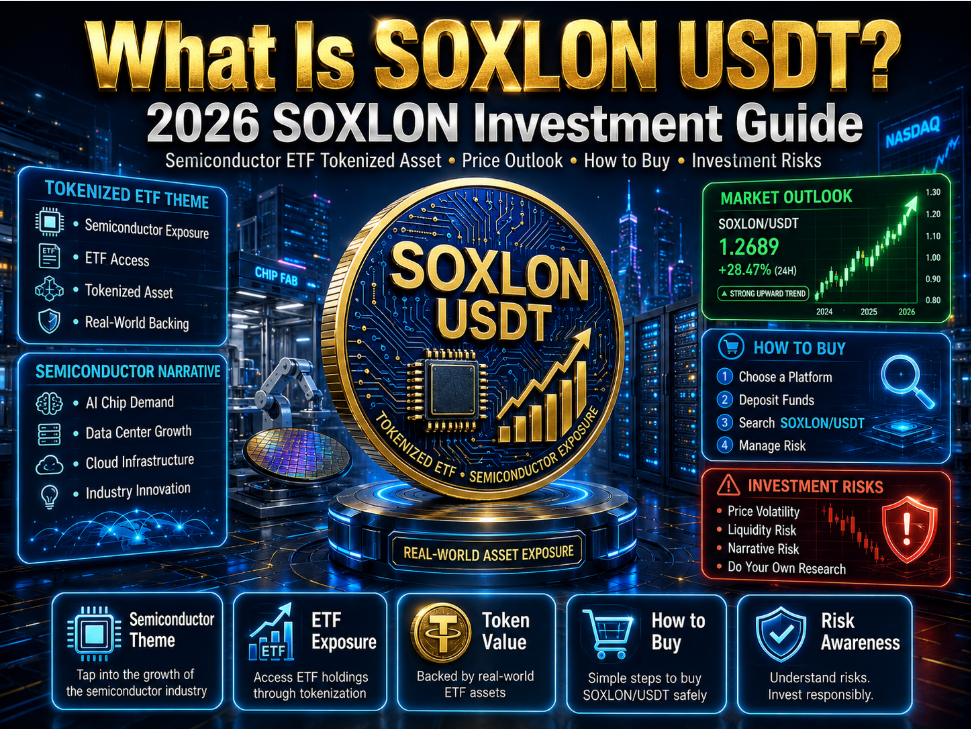
SOXL Semiconductor ETF
↓
Tokenization technology
↓
On-chain asset
↓
SOXLON
↓
Traded with USDT
This represents a growing trend in crypto markets:
In the past, investors could only access through brokerage accounts:
- Stocks
- ETFs
- Bonds
In the future, more traditional assets may become accessible via blockchain wallets and crypto exchanges.
To check SOXLON's current market performance, visit:
SOXLON Real-Time Price & Market Data
Where you can view:
- Current price
- Price changes
- Historical trends
- Market liquidity
Keep in mind:
SOXLON is not a native crypto asset like BTC or ETH. Its price is fundamentally driven by semiconductor sector performance and the value of the underlying SOXL ETF.
What Does SOXLON USDT Mean? Breaking Down SOXL, ON, and USDT
Many newcomers see:
SOXLON/USDT
and mistakenly think it's just another regular crypto trading pair.
In reality, it's helpful to break it down.
What Does SOXL Represent?
SOXL comes from:
Direxion Daily Semiconductor Bull 3X Shares
– a U.S.-listed leveraged ETF focused on semiconductors.
Its primary objective:
Track the daily performance of a semiconductor industry index, with leverage that amplifies the sector's daily moves.
In simple terms:
If the semiconductor sector rises:
SOXL can deliver amplified gains.
If the semiconductor sector falls:
SOXL can also experience amplified losses.
What Does ON Represent?
ON stands for:
Ondo Tokenized Asset framework.
Ondo's core mission:
Tokenize traditional financial assets via blockchain technology.
Examples include:
- Stocks
- ETFs
- U.S. Treasuries
- Other financial assets
Creating on-chain tradable assets.
Similar assets include:
- What is COINON: Coinbase Tokenized Stock
- What is GOOGLON: Google Tokenized Stock
- What is GLWON: Corning Tokenized Stock
What Does USDT Represent?
USDT indicates the trading quote currency.
For example:
SOXLON/USDT
means:
USDT is used as the transaction unit to buy and sell SOXLON.
Similar to:
BTC/USDT
ETH/USDT
But the key difference:
BTC/USDT:
Trades a native crypto asset.
SOXLON/USDT:
Trades a tokenized product of a traditional financial asset.
What Is the SOXL Behind SOXLON? Why Is the Semiconductor ETF Gaining Attention?
What This Section Covers
Many users searching for SOXLON are actually trying to understand:
- What does SOXL invest in?
- Why is the semiconductor industry important?
- How does AI development affect SOXLON?
So understanding SOXL is the first step to understanding SOXLON's value.
What Kind of ETF Is SOXL?
SOXL is a leveraged ETF focused exclusively on the semiconductor sector.
Its core investment universe:
The global semiconductor supply chain, including:
- GPU chip companies
- CPU companies
- AI chip companies
- Semiconductor equipment makers
- Communications chip firms
- Memory chip manufacturers
Key names include:
- NVIDIA
- AMD
- Broadcom
- Qualcomm
- Intel
- TSMC
Investing in SOXL is essentially a bet on:
the entire semiconductor industry cycle.
Why Has Semiconductor Become a Core Asset in the AI Era?
For decades:
Computing advancement drove chip demand.
But since 2023:
Artificial intelligence has become the new growth engine.
AI development path:
Large AI models emerge
↓
Need for more compute power
↓
Need for GPUs
↓
Need for advanced-node chips
↓
Need for high-speed memory
↓
Need for data centers
↓
Driving semiconductor supply chain growth
Thus:
One of the core battlegrounds in the AI era is compute power.
And behind compute power:
You can't escape semiconductors.
How Does AI Drive Semiconductor Demand?
First, AI Server Demand Is Growing
Traditional servers handled:
- Websites
- Databases
- Enterprise applications
AI servers require:
- GPUs
- High-speed networking
- High-bandwidth memory
- Dedicated AI chips
Both cost and chip content rise significantly.
Second, GPUs Have Become the Core of AI Infrastructure
For example:
Training large language models requires:
Massive matrix computations.
This drives demand for:
- NVIDIA GPUs
- AMD AI Accelerators
- Dedicated AI chips
Third, Data Center Expansion
More AI applications
↓
Cloud providers build more data centers
↓
Purchase more servers
↓
Increase chip demand
↓
Fuel the semiconductor investment cycle
What's the Difference Between SOXLON and Individual Semiconductor Stocks?
This is a common point of confusion.
For example, investing directly in NVIDIA:
You take on:
NVIDIA-specific company risk, including:
- Product competition
- Earnings fluctuations
- Management execution
- Market valuation
SOXL, by contrast, invests in:
the entire semiconductor sector.
Advantage:
When the sector rises, multiple companies may contribute to gains.
However, SOXL also has a special feature:
3x leverage.
That means:
On the upside:
Gains can be magnified.
On the downside:
Losses can also be magnified.
So SOXLON is not simply:
"buying the semiconductor industry."
Rather:
participating, via tokenization, in a leveraged ETF that tracks the semiconductor sector.
How Does SOXLON Work? Does It Represent Real Semiconductor ETF Assets?
We've established that SOXLON is not a traditional crypto project.
Now the next questions:
- Is there real asset backing behind SOXLON?
- Does buying SOXLON equal buying the SOXL ETF?
- Is SOXLON just an "air token"?
- How exactly does a tokenized ETF operate?
Understanding these is key to evaluating whether RWA assets deserve attention.
What Is a Tokenized ETF?
A Tokenized ETF is simply a traditional financial ETF that has been converted via blockchain technology into a digital asset tradable within the crypto ecosystem.
Traditional model:
Investor
↓
Brokerage account
↓
Buy ETF
↓
Hold fund shares
Tokenized model:
Investor
↓
Crypto platform
↓
Buy Tokenized ETF
↓
Obtain price exposure to the underlying asset
SOXLON is one example of this model.
It converts:
Direxion Daily Semiconductor Bull 3X Shares (SOXL)
into:
an on-chain tradable asset.
Where Does SOXLON's Value Come From?
A common misconception among newcomers:
"Is SOXLON a new coin?"
No.
SOXLON itself does not generate network value like Bitcoin.
Its value primarily comes from:
SOXL ETF Price Movements
Core logic:
SOXL rises
↓
Reference market value increases
↓
SOXLON theoretical value rises
Conversely:
SOXL falls
↓
SOXLON value declines
So before studying SOXLON, you need to study:
- Semiconductor industry trends
- AI industry cycles
- SOXL ETF performance
- U.S. equity market environment
Not just crypto market hype.
What's the Difference Between SOXLON and the SOXL ETF?
Although highly correlated, they are not identical assets.
What Is the SOXL ETF?
SOXL is a traditional financial product.
Characteristics:
- Traded on U.S. securities exchanges
- Purchased through brokers
- Regulated under securities laws
- Investors hold ETF shares
Example:
An investor buys SOXL through a brokerage account.
What Is SOXLON?
SOXLON is a Tokenized Asset.
Characteristics:
- Available in a crypto trading environment
- Typically quoted in USDT
- Leverages blockchain trading infrastructure
- Provides price exposure to eligible users
The key difference:
SOXL offers traditional ETF ownership, while SOXLON offers on-chain access to the asset's economic exposure.
Therefore:
Buying SOXLON does not mean:
"I now own SOXL fund shares."
More accurately:
The user gains economic exposure tied to SOXL's price performance.
Is SOXLON an RWA Asset?
Answer:
Yes.
SOXLON falls under RWA (Real World Assets) – the tokenization of real-world assets.
RWA's core idea:
Take real-world assets:
- Stocks
- ETFs
- Government bonds
- Gold
- Real estate
and map them onto the digital asset ecosystem via blockchain.
In the past, crypto markets focused mainly on:
Native Digital Assets
Examples:
Bitcoin:
Value from:
- Decentralized network
- Scarcity
- Store-of-value demand
Ethereum:
Value from:
- Smart contract network
- DeFi ecosystem
- Gas demand
See: ETH Price Prediction & Market Analysis
RWA assets, however:
Value derives from:
real-world assets.
For SOXLON:
Value source:
Semiconductor ETF
↓
Semiconductor company earnings
↓
AI industry growth
Thus the investment logic is completely different.
How Does SOXLON Differ From Other RWA Assets?
RWA is expanding rapidly, with different assets catering to different investment theses.
Examples:
Tokenized Stocks
Representatives:
- COINON
- GOOGLON
- GLWON
These track:
Individual company stock values.
For more: What is COINON: Coinbase Tokenized Stock What is GOOGLON: Google Tokenized Stock What is GLWON: Corning Tokenized Stock
Tokenized ETFs
Representative:
SOXLON.
Characteristic:
Not a bet on a single company, but on an entire sector – e.g., semiconductors.
Tokenized Commodities and Industrial Assets
Examples:
Silver, gold, industrial assets, etc.
Related: What is SILV USDT: Tokenized Silver Asset
Why Does SOXLON's Price Change? Core Factors Affecting Its Value
Many users search for:
"SOXLON price prediction"
because they want to know if it will go up or down.
But tokenized ETFs cannot be analyzed like typical altcoins.
SOXLON's price is driven by several key factors.
Factor One: The Semiconductor Industry Cycle
This is the most critical variable.
The semiconductor industry is inherently cyclical.
Upswing:
Chip demand increases
↓
Orders grow
↓
Corporate earnings improve
↓
Stocks rise
↓
SOXL rises
↓
SOXLON value increases
Downturn:
Demand softens
↓
Inventory builds
↓
Pricing pressure
↓
Semiconductor stocks fall
↓
SOXL declines
↓
SOXLON under pressure
Factor Two: AI Industry Development Speed
In 2026, AI remains a major demand driver for semiconductors.
If:
AI models continue to grow
↓
Cloud spending increases
↓
Data center expansion continues
↓
GPU demand rises
↓
Semiconductor demand strengthens
Then SOXLON-related assets could attract market attention.
Investors should monitor:
- AI server buildouts
- Cloud capex
- GPU supply chains
- High-performance computing demand
Factor Three: Valuation Environment for U.S. Tech Stocks
Semiconductor companies are typically growth-oriented tech assets.
Thus:
Interest rates affect valuations.
For example:
Rate-cutting environment:
Lower cost of capital
↓
Growth stock valuations expand
↓
Tech sector benefits
Rate-hiking environment:
Higher cost of capital
↓
Valuation pressure increases
↓
Tech stocks may suffer
Factor Four: SOXL's 3x Leverage Mechanism
This is essential to understand before investing in SOXLON.
SOXL is not a plain-vanilla ETF.
It targets:
3x the daily return of the semiconductor index.
Example:
On a given day:
Semiconductor index rises 5%
Theoretically:
SOXL could rise about 15%.
But if markets are choppy:
Up 10%
↓
Down 10%
The index may end near where it started.
But leveraged ETFs, due to daily rebalancing, can experience:
volatility drag over longer periods.
Therefore:
SOXL is suited for:
- Trend trading
- Sector cycle timing
- Short-to-medium-term positioning
Not a simple:
"buy and forget for ten years."
Factor Five: Crypto Market Liquidity
Although SOXLON's underlying is a semiconductor ETF,
it trades in a crypto market environment.
So it's also influenced by:
- USDT liquidity
- Crypto risk appetite
- Market size and capital flows
- Exchange order-book depth
Example:
During a crypto bull market, capital may be more willing to seek out:
- Tokenized stocks
- Tokenized ETFs
- RWA assets
potentially boosting demand.
But during a broad crypto deleveraging event,
even if the underlying asset is stable,
the token market may experience liquidity dry-ups.
How Should You Approach SOXLON Price Predictions?
SOXLON price prediction isn't a simple answer like "where will it go."
A more reasonable approach uses three analytical frameworks.
Refer to: SOXLON Price Prediction Model & Market Analysis
Bull Case
Potentially requires:
- AI investment continues to grow
- Semiconductor cycle enters expansion
- GPU demand remains strong
- U.S. tech valuations rise
- RWA market expands
Result:
SOXL rises
↓
SOXLON value increases
Base Case
Potential scenario:
- AI continues to develop
- Semiconductors maintain growth
- But expectations are already priced in
Result:
SOXLON trends higher with volatility.
Bear Case
Potential factors:
- AI capex slows
- Semiconductor inventory builds
- Global economic slowdown
- Tech valuations contract
- Crypto liquidity shrinks
Result:
SOXLON could experience significant volatility.
Before Investing in SOXLON, Understand This Core Principle
Many newcomers see:
"AI + chips + Crypto + RWA"
and immediately think SOXLON must be an opportunity.
But a professional analysis should follow this order:
First:
Study the semiconductor industry.
↓
Second:
Study AI industry trends.
↓
Third:
Study the SOXL ETF mechanics.
↓
Fourth:
Study SOXLON's tokenization structure.
↓
Fifth:
Judge whether the current price is reasonable.
Because:
A good asset doesn't mean it's a good buy at any price.
How to Buy SOXLON USDT? A Complete Step-by-Step Guide for Beginners
For first-time SOXLON investors, the most common questions are:
- Where can I buy SOXLON?
- How do I buy SOXLON USDT?
- What do I need to prepare?
- Is it the same as buying BTC?
- Should I hold long-term or trade short-term?
Since SOXLON is a Tokenized ETF, it differs significantly from ordinary crypto assets.
Investors need to understand not just the trading process, but also:
that you are buying price exposure to a semiconductor leveraged ETF, not a traditional stock or a typical token.
What to Prepare Before Investing in SOXLON?
Before buying SOXLON, it's wise to complete a few basic steps.
Step 1: Understand SOXLON's Underlying Asset
Don't buy just because you see buzzwords like:
"AI"
"Semiconductors"
"RWA"
First confirm:
SOXLON
↓
Corresponds to SOXL ETF
↓
Semiconductor sector
↓
Companies like NVIDIA, AMD, Broadcom, and the supply chain
So before buying, understand:
- Semiconductor industry trends
- AI industry development
- SOXL ETF leverage mechanics
- Current market valuations
Step 2: Prepare USDT Funds
SOXLON is typically traded as:
SOXLON/USDT
So you'll need USDT.
USDT's role:
Not the investment itself, but:
- The trading quote currency
- A means to facilitate liquidity
- The medium to buy and sell SOXLON
Example:
If:
SOXLON price = 100 USDT
Then buying 1 SOXLON costs about 100 USDT.
Step 3: Choose a Platform That Supports SOXLON Trading
On the exchange, verify:
- Whether SOXLON is listed
- Whether the SOXLON/USDT pair is active
- Current order-book depth
- Bid-ask spread
For tokenized assets, liquidity is critical.
Because:
With low volume, you may encounter:
- Higher buy prices
- Discounted sell prices
- Increased slippage
How to Buy SOXLON USDT (Using Hibt as an Example)
If Hibt offers SOXLON trading, here's a typical process.
Step 1: Register a Trading Account
On the exchange:
Complete:
- Account registration
- Email or phone verification
- Security settings
Recommended:
- Google Authenticator
- Two-factor authentication (2FA)
Why:
Tokenized assets often involve significant value, so account security is paramount.
Step 2: Deposit USDT
Transfer USDT to your exchange account.
When depositing, verify:
- USDT network type (e.g., ERC-20, BEP-20, TRC-20)
- Deposit address
- Network fees
Using the wrong network may result in lost funds.
Step 3: Search for the SOXLON Trading Pair
Go to the trading page.
Search: SOXLON
Check:
- SOXLON/USDT
- Current price
- 24-hour volume
- Order book
Key focus: Don't just look at price.
Also examine:
Trading Volume
Indicates market activity.
Bid-Ask Spread
Example:
Buy: 100 USDT
Sell: 98 USDT
Wider spread = higher trading cost.
Order-Book Depth
Check whether large orders can be filled easily.
Step 4: Choose Your Order Type
Typically two options.
Market Order
Executes immediately.
Suitable for:
- Beginners buying quickly
- Small amounts
Downside:
If liquidity is thin, slippage may occur.
Example:
You see: 100 USDT
After clicking buy, you actually fill at 101 USDT.
Limit Order
You set your own price.
Example:
Current: 100 USDT
You want to buy at 98 USDT.
Set a limit order at 98 USDT.
Advantage: You control your entry price.
Disadvantage: May not fill.
Step 5: How to Manage SOXLON After Purchase?
Once you own SOXLON, don't just watch its price.
Monitor these core indicators:
Track the SOXL ETF
Because SOXLON's value is tied to SOXL.
Watch:
- SOXL price
- Semiconductor index
- NVIDIA trends
- AMD trends
Track AI Industry Trends
Including:
- AI server demand
- Cloud capex
- GPU supply chain
- Data center construction
Monitor the Crypto Market Environment
Even though SOXLON isn't BTC,
it still trades in crypto markets.
Watch:
- BTC trends
- USDT liquidity
- RWA market sentiment
See: BTC Price Trends & Market Forecast
Is SOXLON Better for Long-Term Investing or Short-Term Trading?
This is a common question.
Answer: It depends on your goals.
What Should Long-Term Investors Consider?
Many see:
AI long-term growth
↓
Semiconductor long-term demand
↓
and assume SOXLON is a long-term hold.
But note:
SOXL itself is a 3x leveraged ETF.
Long-term holding introduces:
- Volatility drag
- Rebalancing effects
- Sector cycle risk
Therefore: Being bullish on AI long-term ≠ blindly holding SOXLON forever.
Why Do Swing Traders Pay Attention to SOXLON?
SOXLON may suit cycle traders.
For example:
If you anticipate:
AI momentum starting
↓
Semiconductors rally
↓
SOXL rises
↓
SOXLON benefits
In such cases, swing opportunities may be clearer.
What Should Short-Term Traders Focus On?
Short-term focus:
Semiconductor News
Examples:
- NVIDIA earnings
- AI chip launches
- Data center orders
U.S. Equity Market Moves
Particularly:
- Nasdaq index
- Semiconductor index
- Tech sentiment
Crypto Trading Data
Including:
- Volume
- Liquidity
- Order book levels
What's the Difference Between SOXLON and BTC/ETH? Asset Allocation Perspective
Many crypto users ask: "If SOXLON is tradable, why not just buy BTC?"
Because SOXLON and BTC are fundamentally different asset classes.
SOXLON vs BTC: Industrial Asset vs Digital Asset
What Is BTC?
Bitcoin is a:
native crypto asset.
Value sources:
- Decentralized network
- Scarce supply
- Market consensus
- Macro asset properties
BTC price is mainly driven by:
- Capital inflows
- Macro environment
- Institutional demand
What Is SOXLON?
SOXLON is a:
tokenized real-world asset.
Value source:
The semiconductor industry.
Logic:
AI demand
↓
Chip industry
↓
Semiconductor companies
↓
SOXL ETF
↓
SOXLON
In simple terms:
BTC: bet on the digital currency ecosystem.
SOXLON: bet on AI and the semiconductor industry.
SOXLON vs ETH: Network Value vs Industrial Value
ETH's value comes from:
- Ethereum network
- Smart contracts
- DeFi
- Layer 2 ecosystems
- Gas demand
See: ETH Price Prediction & Market Analysis
SOXLON's value comes from:
- Semiconductor industry growth
- AI infrastructure demand
- SOXL ETF performance
The investment logic is entirely different.
Why Are RWA Assets Becoming an Important Crypto Sector?
In the past, crypto markets:
Major assets were:
BTC ETH DeFi tokens Meme coins
RWA is now bridging:
Traditional finance
and
Blockchain.
In the future, we may see:
Stocks
↓
ETFs
↓
Bonds
↓
Commodities
↓
Real estate
all moving on-chain.
Current Hibt RWA-related asset examples include:
CXMTUSDT
China-related semiconductor asset: What is CXMTUSDT: Changxin Memory & Semiconductor Asset
COINON
Coinbase tokenized stock: What is COINON: Coinbase Tokenized Stock
GOOGLON
Google tokenized stock: What is GOOGLON: Alphabet Tokenized Stock
GLWON
Corning tokenized stock: What is GLWON: Corning AI Optical Communications Asset
One Sentence You Must Understand Before Investing in SOXLON
SOXLON's defining feature is not "is it a new coin."
It is: It allows crypto users to gain on-chain exposure to a traditional semiconductor ETF asset.
But tokenization does not eliminate investment risk.
SOXLON remains subject to:
- Semiconductor cycles
- AI industry changes
- ETF leverage mechanics
- U.S. equity markets
- Crypto liquidity
all acting together.
What Are the Risks of Investing in SOXLON? Four Major Risk Categories to Know Before Buying
Many investors see:
AI
- Semiconductors
- ETFs
- RWA
- Crypto
and naturally think:
"Is SOXLON a new opportunity combining tech growth and crypto innovation?"
But professional analysis must look beyond the upside.
SOXLON actually layers together:
- Semiconductor industry risk
- Leveraged ETF risk
- Tokenized asset risk
- Crypto market risk
So before considering SOXLON, a full understanding of these risks is essential.
Semiconductor Industry Risk: AI Growth Doesn't Mean All Chip Assets Rise Forever
SOXLON's biggest underlying variable is:
semiconductor industry performance.
And while semiconductors have long-term growth, they are also a classic cyclical industry.
Chips Have Supply-Demand Cycles
Semiconductor markets often see:
Demand rises
↓
Companies expand capacity
↓
Supply increases
↓
Inventory builds
↓
Prices fall
↓
Industry corrects
Example:
When AI server demand surges: GPUs, advanced chips, memory all see higher demand.
But if:
Global economy slows
↓
Enterprises cut IT spending
↓
Data center construction slows
↓
Chip demand drops
Semiconductor stocks may be affected.
Slowing AI Investment Could Impact SOXLON Expectations
Current semiconductor valuations are largely supported by:
AI growth expectations.
If we see:
- AI commercialization slower than expected
- Cloud providers reduce capex
- AI server demand weakens
- GPU oversupply
Then:
AI-related stocks
↓
Semiconductor stocks
↓
SOXL ETF
↓
SOXLON
could all come under pressure.
3x Leveraged ETF Risk: SOXLON's Biggest Unique Risk
This is the most overlooked issue.
Many understand: SOXL = semiconductor ETF.
But SOXL is not a plain ETF.
It is a 3x leveraged semiconductor ETF.
What Is Daily 3x Leverage?
Simply put: if the semiconductor index rises 5%, SOXL could theoretically rise about 15%.
If the index falls 5%, SOXL could fall about 15%.
So in an uptrend: leverage magnifies gains.
In a downtrend: leverage magnifies losses.
Why Isn't a Leveraged ETF Suited for Simple Long-Term Holding?
Many newcomers think:
"Since AI will grow for the next decade, I'll just hold SOXLON forever."
But the problem is that leveraged ETFs have a daily reset mechanism.
Example:
Day 1: market rises 10%
Day 2: market falls 10%
Normal index: 100 → 110 → 99 (back near start)
But a leveraged ETF, due to daily rebalancing, can suffer from volatility drag over time.
Therefore:
SOXLON is better suited for:
- Trend timing
- Sector cycle trading
- Swing/position trading
rather than:
ignoring volatility and holding indefinitely.
Tokenized Asset Risk: On-Chain Asset ≠ No Structural Risk
SOXLON is an RWA asset.
RWA advantage: bringing traditional finance on-chain.
But tokenization does not eliminate financial risk.
Issuer Risk
Investors should consider:
- Token issuance mechanics
- Underlying asset arrangement
- Custodians
- Redemption mechanisms
Because:
You hold a tokenized asset, not ETF shares in a traditional brokerage account.
Underlying Asset Mapping Risk
SOXLON's value depends on the SOXL ETF.
So you need to track:
- Whether it effectively mirrors the underlying
- Whether price deviations exist
- Whether it functions properly in extreme markets
Liquidity Risk
This is often overlooked with tokenized stocks/ETFs.
Traditional ETFs have deep, mature markets.
Tokenized assets may face:
- Low trading volume
- Wide bid-ask spreads
- Inability to execute quickly in volatile conditions
Example:
During a rapid rally, buy demand surges.
But if sell-side liquidity is thin,
SOXLON may temporarily trade away from its theoretical value.
Regulatory and Geographic Restrictions Risk
Tokenized securities involve:
- Securities regulation
- Investor eligibility
- Geographic limitations
Different countries may have different rules.
So investors must confirm:
- Whether their region is supported
- Whether the platform is open to them
- Whether product rules may change
Crypto Market Risk: Even With an ETF Underlying, It's Still Affected by the Crypto Trading Environment
Many think:
"SOXLON isn't a coin, so it won't be affected by crypto."
That's not entirely accurate.
Because:
SOXLON trades in the crypto ecosystem.
USDT Liquidity Risk
SOXLON is typically traded as:
SOXLON/USDT.
So changes in USDT market liquidity can affect:
- Order-book depth
- Trading costs
- Market price
Broader Crypto Volatility Risk
Example:
BTC suddenly drops sharply.
Markets see a risk-off move.
Investors may reduce exposure to:
- Tokenized stocks
- RWA assets
- Higher-risk positions
Causing:
Even if SOXL's underlying is stable,
SOXLON may see short-term pressure.
For overall BTC market trends: BTC Price Prediction & Market Analysis
Exchange Risk
Investors should also consider:
- Platform security
- Asset custody
- Withdrawal rules
- Ongoing product availability
Tokenized assets add an extra layer of traditional finance connectivity compared to ordinary crypto, making the risk structure more complex.
Future Trends for SOXLON: Will AI + Semiconductors + RWA Become a New Investment Frontier?
Despite the risks, SOXLON represents an important trend:
Crypto is evolving from purely trading digital currencies to connecting with traditional financial assets.
Why Will Semiconductors Remain Important in the AI Era?
In the coming years, AI applications will likely continue to drive:
AI Training
Requires:
- GPUs
- High-performance compute chips
AI Inference
Requires:
- Data centers
- Cloud computing
- Specialized chips
Edge AI
Requires:
- Mobile chips
- Automotive chips
- IoT chips
All these trends reinforce:
the importance of the semiconductor industry.
Why Could RWA Become a Long-Term Direction for Crypto?
In the past:
Crypto mainly solved:
digital currency transfer.
In the future:
It may further connect:
real-world financial markets.
Examples:
Stocks
↓
ETFs
↓
Bonds
↓
Commodities
↓
Funds
all potentially entering the blockchain via tokenized form.
What Trend Does SOXLON Represent?
SOXLON's significance goes beyond being just a trading product.
It represents:
Traditional financial assets
↓
Blockchain infrastructure
↓
Global user access
as a development path.
In the future, investors might use a single crypto account to access:
- Bitcoin
- Ethereum
- U.S. equities
- ETFs
- Commodity assets
More RWA Assets Worth Exploring
To learn more about tokenized assets, check out:
What is CXMTUSDT: Changxin Memory, Domestic DRAM & Semiconductor Asset
What is COINON: Coinbase Tokenized Stock Asset
What is GOOGLON: Google Tokenized Stock Asset
What is GLWON: Corning Stock, AI Data Centers & Ondo Tokenized Asset
Who Is SOXLON Suitable For? Final Investment Assessment
SOXLON is not for everyone.
It is better suited for:
Those Who May Consider SOXLON
Bullish on AI's Long-Term Growth
Believing that:
AI infrastructure
↓
Compute demand growth
↓
Semiconductor industry benefits
Interested in RWA Development
Wanting to access traditional assets via crypto channels.
Comfortable with High Volatility
Understanding:
- Leveraged ETFs
- Sector cycles
- Token risks
Who Should Be Cautious About SOXLON
The following investors should proceed carefully:
Those Unfamiliar with Leveraged ETF Mechanics
If you don't understand:
daily reset
volatility drag
it's better to stay away.
Those Buying Only Because "AI Is Hot"
AI is a long-term trend.
But: hot sector ≠ every price is fair.
Those Seeking Stable Returns
SOXLON carries:
- Sector risk
- Leverage risk
- Market risk
It is not a low-volatility asset.
FAQ: Common Questions About SOXLON
What is SOXLON USDT?
SOXLON USDT is a tokenized asset based on the semiconductor ETF SOXL, priced in USDT.
It is not a traditional cryptocurrency.
Is SOXLON a coin?
Strictly speaking, SOXLON is not a native crypto token like BTC or ETH.
It is a Tokenized ETF / RWA asset.
What is the relationship between SOXLON and SOXL?
SOXL is a U.S. 3x leveraged semiconductor ETF.
SOXLON is a tokenized asset designed to track SOXL's value performance.
Can I buy SOXLON and hold it long-term?
Proceed with caution.
Because the underlying SOXL has 3x leverage,
long-term holding may be affected by:
- Volatility drag
- Industry cycles
What determines SOXLON's price?
Key factors include:
- SOXL ETF price
- Semiconductor sector performance
- AI industry development
- U.S. tech stock environment
- Crypto liquidity
Is SOXLON an RWA asset?
Yes.
It falls under Real World Assets tokenization.
Is SOXLON safe?
It cannot be simply considered safe.
It carries:
- Semiconductor industry risk
- Leveraged ETF risk
- Token structural risk
- Crypto market risk
How do I buy SOXLON?
Generally:
- Prepare USDT.
- Find a platform that supports SOXLON.
- Search for SOXLON/USDT.
- Trade based on liquidity and price.
Before buying, confirm:
- Product rules
- Regional restrictions
- Current trading status
Conclusion: SOXLON Is Not a "New Coin," but a Bridge Bringing Semiconductor Assets into Crypto in the AI Era
SOXLON's greatest value is not whether it becomes the next hot crypto.
It truly represents the convergence of:
AI industry trends + semiconductor sector + RWA asset tokenization
Understanding SOXLON properly means following this order:
First: Study AI and semiconductor industry trends.
↓
Second: Understand SOXL ETF's 3x leverage mechanics.
↓
Third: Understand how tokenized ETFs connect to traditional finance.
↓
Fourth: Analyze SOXLON's own liquidity and trading costs.
↓
Fifth: Assess your own risk tolerance before deciding to participate.
For investors, the most important question is not:
"Will SOXLON definitely go up?"
Rather:
Do I truly understand that I am trading a tokenized version of a semiconductor leveraged ETF, not an ordinary cryptocurrency?
Only by grasping the asset's true nature can you rationally decide whether SOXLON belongs in your portfolio.