
Risk Warning:
This article systematically breaks down and analyzes the GMT coin based on public information. The content is solely for crypto asset research and educational purposes and does not constitute any investment advice. GMT is a high-volatility, high-risk asset. Before investing, please make independent judgments based on your personal risk tolerance.
Introduction: From "Walk-to-Earn" to Reality—What Happened to GMT?
If you've heard of "walk-to-earn" crypto projects, you've likely encountered the story behind GMT. In 2022, STEPN quickly went mainstream with its Move-to-Earn (M2E) model. Users simply needed to buy NFT sneakers and walk, jog, or run to earn token rewards. The narrative sounded simple, exciting, and highly appealing to newcomers: Why not give it a try if I can make money just by exercising every day?
However, years later, market sentiment surrounding GMT has drastically shifted. It was once fervently chased at the tail end of the bull market, but has since experienced price crashes, user churn, the fading of the GameFi narrative, and intense debates over the sustainability of Move-to-Earn. When many newcomers search for "What is GMT coin" today, what they truly want to know isn't just a simple definition, but rather:
- What exactly is GMT?
- How is it related to STEPN?
- What is the difference between GMT and GST?
- Why was it so popular, and why did it crash so heavily?
- Does GMT still have value today?
- If I want to buy GMT, how do I do it?
This article will systematically unpack GMT coin from the perspectives of project fundamentals, token mechanics, historical price action, current ecosystem status, risk factors, the HiBT buying process, and investor suitability.
Note: The content of this article is based on STEPN's official documentation, public on-chain data platforms, and market information. It is for research and learning purposes only and does not constitute investment advice.
I. What Exactly is GMT? It's Not Just a "Walk-to-Earn Coin"
1. What Does GMT Stand For?
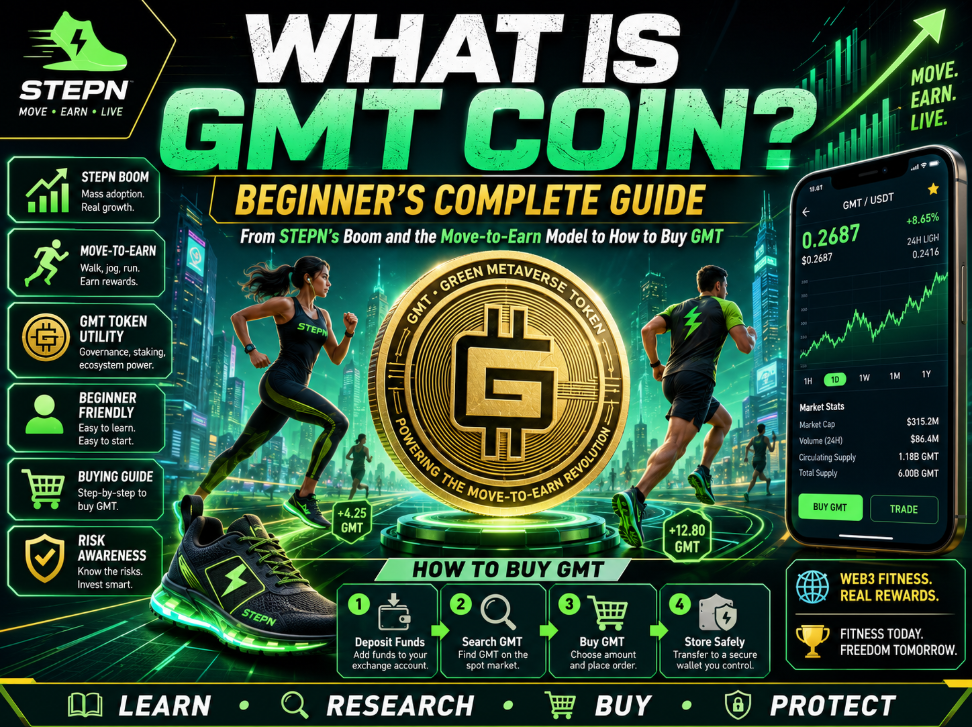
GMT stands for Green Metaverse Token, which is the governance token of the STEPN ecosystem.
STEPN is a Web3 lifestyle app developed by Find Satoshi Lab, centered around the "Move-to-Earn" concept (earning rewards through physical movement). Users can buy NFT sneakers within the app and participate in the game's economic system by walking, jogging, or running.
In the STEPN ecosystem, GMT is not an isolated meme coin, nor is it purely a payment token. Its value is derived primarily from the STEPN ecosystem itself, including in-game features, governance, marketplace trading, ecosystem incentives, and the expansion of Find Satoshi Lab's future product lines.
In short: GMT is the core governance token of the STEPN ecosystem, representing premium privileges, governance participation, and specific utility scenarios within the Move-to-Earn ecosystem.
2. What is Move-to-Earn?
Move-to-Earn can be understood as a model that combines GameFi with real-world physical activity.
In traditional games, users earn items, points, or tokens by playing. STEPN replaced this behavior with real-world exercise:
- Users purchase NFT sneakers.
- Users use the App daily to track their movement.
- The system calculates rewards based on movement data, sneaker attributes, and energy levels.
- Users receive associated tokens like GST or GMT.
- Users can spend these tokens on leveling up, repairing, minting (breeding), trading, or other ecosystem functions.
This model was incredibly attractive in 2022 because it seamlessly blended three concepts:
- Healthy living
- Play-to-Earn mechanics
- The expectation of crypto asset appreciation
3. What is the Difference Between GMT and GST?
The easiest point of confusion for beginners is distinguishing between GMT and GST. Both belong to the STEPN ecosystem, but their roles are completely different.
GST (Green Satoshi Token) is STEPN's in-game utility token. It acts more like a consumable in-game currency used for daily movement rewards and in-game mechanics.
- Used for daily movement rewards.
- Used to repair NFT sneakers.
- Used to level up sneakers.
- Used for opening mystery boxes, upgrading gems, and shoe-minting.
- It has an uncapped (infinite) supply.
- Highly susceptible to the balance of in-game production and consumption.
GMT (Green Metaverse Token) is STEPN's governance token.
- Has a fixed maximum supply of 6 billion tokens.
- Positioned for governance and ecosystem value capture.
- Used for specific premium/high-level features.
- Used in the STEPN marketplace and broader ecosystem scenarios like MOOAR.
- More heavily influenced by the overall development of the FSL ecosystem, exchange liquidity, and broader market narratives.
To put it simply:
- GST is like "in-game gold."
- GMT is like an "ecosystem equity token."
If too much GST is produced and its price drops, users' earning expectations decline, which hurts STEPN's ecosystem activity. If STEPN's activity drops, GMT's long-term value will also face severe pressure.
4. What Blockchains Does GMT Run On?
GMT was initially deeply tied to the Solana ecosystem but later expanded to networks like BNB Chain and Polygon. According to STEPN's official whitepaper, GMT has multiple smart contract addresses across different chains.
This brings two critical reminders for beginners:
- Verify the supported network when buying/depositing: Different exchanges support different chains. Always ensure the network matches before transferring.
- Verify contract addresses before on-chain transfers: The market is full of fake GMT tokens, copycat projects, or scam tokens with similar names. Don't just look at the ticker; always verify the official contract address.
5. Is GMT a Governance Token or a Utility Token?
Strictly speaking, GMT is a governance token, but it is not merely a voting tool. It serves several functions:
- STEPN ecosystem governance.
- High-level NFT sneaker features.
- Premium in-game consumable mechanics.
- Marketplace trading and ecosystem applications.
- Potential utility across other product lines under FSL.
Therefore, GMT is a core value token within the STEPN and Find Satoshi Lab ecosystem. However, this also means its value depends heavily on real ecosystem demand. If STEPN loses users, the M2E narrative fades, or utility scenarios fall short, GMT's price support will weaken.
II. What is the STEPN Project? Where Does GMT's Value Come From?
1. What is STEPN's Core Gameplay?
STEPN is a Web3 app blending fitness, NFTs, and crypto tokens. The basic loop involves:
- Downloading the STEPN App.
- Registering an account and connecting a wallet.
- Buying NFT sneakers.
- Walking, jogging, or running based on the sneaker type.
- Letting the App record movement data.
- Earning token rewards based on the rules.
- Spending tokens to repair, level up, mint, or trade NFT sneakers.
STEPN's core isn't just "making people exercise"; it's designing a closed-loop economy combining physical activity, game economics, NFT assets, and token incentives.
In this loop, GMT's value comes from three areas:
- Users' willingness to continue participating in STEPN.
- Sufficient in-game scenarios to burn/consume GMT.
- FSL's ability to expand GMT into more products and apps.
2. Who is the Find Satoshi Lab Team?
Find Satoshi Lab (FSL) is the development team behind STEPN. They are not a one-product studio; they are building a matrix of Web3 consumer applications. FSL's product lineup includes:
- STEPN: The Move-to-Earn lifestyle app.
- MOOAR: An NFT marketplace and Launchpad.
- DOOAR: A decentralized exchange (DEX) product.
- Gas Hero: A Web3 social strategy game.
- Other tools and apps revolving around the FSL ecosystem.
This indicates that GMT's long-term narrative isn't confined to STEPN alone. If FSL successfully integrates more products, GMT's utility expands. Conversely, if these new products fail to attract real users, this "ecosystem expansion" remains just a narrative without actual demand.
3. Why Did STEPN Go Viral?
STEPN's explosive popularity wasn't an accident. Several key factors contributed:
- Timing: It launched perfectly in the wake of the 2021-2022 GameFi and NFT crazes.
- Low Barrier to Entry: Move-to-Earn is much easier for ordinary people to understand than complex Play-to-Earn mechanics. Walking is a daily habit.
- Strong Early ROI Expectations: During the price surges of GMT and GST, users calculating their "payback period" (ROI) drove massive FOMO and new user adoption.
- Solana Hype: STEPN was deeply tied to Solana during a period of high attention and capital inflow into the ecosystem.
- Social Virality: "Earning money by walking daily" is a highly shareable story, spreading like wildfire across Twitter, YouTube, Discord, and global communities.
4. How Does STEPN Differ from Other GameFi Projects?
Unlike standard blockchain games, STEPN has distinct differences:
- It doesn't require users to sit at a computer playing complex games.
- It tokenizes real-world physical movement.
- It carries strong lifestyle and fitness attributes.
- It easily attracted non-traditional gamers early on.
- Its NFT sneakers possess strong asset-like characteristics.
However, these differences brought unique challenges. If a regular game isn't fun, users leave. If a Move-to-Earn app stops being profitable, users also leave. The core challenge for STEPN is converting users from "just here for the money" to treating the app as a long-term fitness, social, and asset-management tool. This is the key to GMT's long-term value.
III. GMT Tokenomics: Supply Mechanics Determine the Price Ceiling
1. What is GMT's Total Supply?
GMT has a hard-capped maximum supply of 6 billion tokens.
Unlike GST, GMT is not infinite. While a fixed supply theoretically aids a scarcity narrative, it doesn't guarantee price appreciation. The token price is collectively determined by:
- Total supply and circulating supply.
- Unlocks and vesting schedules.
- Market demand and exchange liquidity.
- Actual project revenue and user growth.
- Token burn/consumption mechanics.
If circulating supply continues to increase without a proportional rise in market demand, the price will face downward pressure.
2. How Should We View GMT's Allocation Structure?
For any crypto project, beginners must look at token allocation. Key areas include the percentage for the team, investors, ecosystem fund, community rewards, and public sales, as well as the unlock schedule.
For GMT, the allocation involves ecosystem incentives, investors, the team, and user rewards. The most important thing isn't memorizing the percentages, but understanding one core question: When new GMT unlocks and hits the market, is there enough new demand to absorb this supply? If not, unlocks turn into continuous sell pressure.
3. Does GMT Have Deflationary Mechanics?
GMT is designed with a fixed supply cap and possesses various consumption (burn) scenarios within the STEPN ecosystem, such as:
- Specific premium in-game features.
- High-level sneaker operations.
- Marketplace purchases and ecosystem app usage.
- Participation in governance or ecosystem events.
- Usage within FSL ecosystem platforms like MOOAR.
Theoretically, if STEPN and FSL ecosystem activity rises, GMT consumption increases, supporting the price. However, this relies on two variables:
- Are there actually enough users willing to burn GMT?
- Is the burn rate high enough to offset token unlocks, sell pressure, and declining liquidity?
If consumption scenarios are insufficient, the deflationary narrative will struggle to support the price.
4. Why Does GST Oversupply Affect GMT?
Many assume that a GST crash only affects GST. In reality, there is a direct contagion effect.
GST is the primary reward token. If GST's price drops, the daily earnings of users drop, killing the incentive for new users to buy NFT sneakers. The chain reaction looks like this:
- GST price drops.
- User earnings decline.
- New user acquisition stalls.
- Demand for NFT sneakers drops.
- Veteran users exit.
- In-game activity plummets.
- Expectations for GMT's ecosystem value weaken.
This is the classic "death spiral" inherent to many Move-to-Earn projects. If the reward token crashes, the governance token will inevitably suffer alongside it.
5. How is GMT Similar to Tokens like AXS and SAND?
GMT, AXS, and SAND are all "ecosystem tokens."
Similarities:
- Heavily reliant on their project's ecosystem.
- Driven by GameFi or Metaverse narratives.
- Experienced massive bull market valuations.
- Suffered severe drawdowns once the hype faded.
- Urgently require new, real demand to sustain long-term value.
Differences:
- AXS relies on Axie Infinity's gaming economy.
- SAND relies on The Sandbox's virtual land and metaverse content.
- GMT relies on STEPN's M2E ecosystem and FSL's product matrix.
GMT's advantage is its integration into daily life (walking is easier to understand than complex games). Its disadvantage is the high controversy surrounding its earning model—once the "walk-to-earn" ROI drops, user retention faces massive pressure.
IV. GMT Price History Review: From Boom to Bust, What Happened?
1. When Did GMT Launch?
GMT entered the mainstream market in 2022 and quickly became one of the most watched Move-to-Earn tokens of its time. Early on, it benefited from several tailwinds:
- The GameFi craze was still warm.
- The NFT market hadn't completely cooled.
- High attention on the Solana ecosystem.
- Mainstream exchange listings providing deep liquidity.
- The M2E narrative was incredibly fresh.
2. Why Did GMT Skyrocket in 2022?
The 2022 explosion was driven by several overlapping factors:
- M2E Narrative Breakout: The market loved the new, highly shareable story of earning money by walking.
- Rapid User Growth: Early adopters experienced high returns and actively invited friends, creating a social viral loop.
- Surging NFT Demand: To play, users needed sneakers, driving up the perceived prosperity of the ecosystem.
- Wealth Effect: Rising GMT and GST prices strengthened ROI expectations, drawing in massive FOMO.
- Exchange & Media Hype: Mainstream coverage brought in waves of short-term speculative capital.
This created a classic bull market positive feedback loop: Price rises → Users increase → Ecosystem gets hotter → More people buy in → Price rises further.
3. Why Did GMT Crash Later?
The subsequent crash was due to multiple converging factors:
- Macro GameFi Decline: Post-2022, market risk appetite shrank, and GameFi projects universally collapsed.
- User Growth Stalled: The M2E model relies heavily on a constant influx of new users. Once growth slowed, demand for NFTs and tokens plummeted.
- GST Price Pressure: Overproduction and underconsumption of GST caused its price to tank, directly killing user ROI expectations.
- Lengthened ROI Periods: As payback periods grew longer, willingness to participate evaporated.
- Sustainability Scrutiny: The market stopped buying the story and started asking if the model could survive without new users.
- GMT Unlocks: As demand fell, circulating supply kept increasing through unlocks, naturally crushing the price.
4. Did GMT Rebound in 2023–2024?
While GMT hasn't been completely dead, it is no longer a mainstream market narrative. Occasional rebounds have generally been triggered by:
- Bitcoin dragging the entire crypto market up.
- Short-term revivals in GameFi or SocialFi sectors.
- FSL releasing new products or features.
- Exchange campaigns stimulating short-term volume.
- Capital hunting for "bottomed-out" assets.
However, these were mostly temporary rallies and did not fundamentally reverse the massive structural pressure on GMT since its ATH.
5. What Does the Distance from the All-Time High Mean?
GMT is currently trading far below its historical peak. For beginners, this can be interpreted in two ways:
- The Optimistic View: It's incredibly "cheap" compared to its ATH. If M2E returns or FSL's expansion succeeds, there is massive upside potential.
- The Cautious View: A massive drop doesn't mean it's cheap. Many GameFi tokens drop 90% and then drop another 90%. The ATH was likely a bull market bubble that may never return. Without real user and revenue recovery, a long-term price fix is highly unlikely.
Therefore, "it dropped a lot" is not a valid investment thesis. The real question is: Can GMT generate new, authentic demand in the future?
V. Is GMT Still Alive? Current Project Status and Ecosystem Updates
1. Is STEPN Still Operating?
Yes, STEPN has not disappeared. The app, users, community, and ecosystem updates still exist, though market enthusiasm is a fraction of its 2022 peak. You can determine it's "alive" because:
- The App functions normally.
- Official social media is updated regularly.
- Users are still interacting on-chain.
- The NFT marketplace still sees volume.
- GMT maintains liquidity on major exchanges.
- The team continues to ship new products.
However, just because a project isn't dead doesn't guarantee its token holds investment value.
2. Is the FSL Ecosystem Still Expanding?
Find Satoshi Lab hasn't stopped at STEPN. They have launched MOOAR, DOOAR, and Gas Hero. For investors, this means:
- If FSL successfully unifies these products, GMT's utility expands.
- If these products attract real users and generate revenue that flows back into the ecosystem, GMT benefits.
- If the connection is in name only, GMT's value capture will be minimal.
3. How is GMT's Liquidity?
Liquidity is often overlooked by beginners. You must check:
- 24-hour trading volume.
- Presence on tier-1 exchanges.
- Order book depth (to avoid severe slippage).
- Whether volume is overly concentrated on one small exchange.
If liquidity is poor, buying or selling large amounts becomes dangerous. Therefore, if considering GMT, avoid heavy, single-entry lump-sum buys.
4. How is Community Activity?
Look past official announcements. Is there real discussion on Twitter, Discord, and Reddit? Are people talking about game strategies and fitness, or just complaining about the price? A project with a community still discussing the product has a much better foundation than one filled only with bots or price speculators.
5. What Does Mainstream Exchange Support Indicate?
The fact that GMT is still listed on major exchanges proves it retains a baseline of market attention, trading demand, and liquidity. However, it does not mean GMT is guaranteed to rise, that STEPN has returned to its peak, or that the current price is the absolute bottom. Exchange support is a prerequisite, not an investment thesis.
VI. Five Risks You Must Know Before Buying GMT
Before discussing how to buy, we must address the risks. GMT is a high-risk narrative asset, not a blue-chip like BTC or ETH.
- 1. Ponzi-nomics Controversy Risk (Probability: High | Impact: High): The biggest debate around M2E is its reliance on new capital to pay early adopters. While STEPN is a real product, its economic model was historically dependent on growth. Advice: Strictly control your position size.
- 2. GST Oversupply Contagion (Probability: Medium | Impact: Medium): If GST crashes due to overproduction, user ROI drops, triggering a death spiral that directly impacts GMT's long-term value. Advice: Monitor GST prices and burn mechanics closely.
- 3. Liquidity Risk (Probability: Medium | Impact: High): With lower market heat, large orders can cause severe slippage. Advice: Use limit orders and avoid massive, sudden trades.
- 4. Team Centralization Risk (Probability: Low-Med | Impact: High): GMT's future relies heavily on FSL's execution, transparency, and ecosystem fund management. Advice: Track official updates and governance decisions.
- 5. Narrative Decay Risk (Probability: High | Impact: Medium): M2E is no longer the hottest narrative (currently outshined by AI, RWA, Memes, DePIN, etc.). Without narrative revival, GMT relies purely on short-term speculative emotion. Advice: Don't buy just because it was once famous.
VII. How to Buy GMT on HiBT: A Step-by-Step Guide for Beginners
Reminder: The following is an educational walkthrough of the trading process, not a recommendation to buy GMT. Beginners should thoroughly research the asset and start with small amounts if participating.
1. Why Choose HiBT to Buy GMT?
For beginners, navigating decentralized exchanges (DEXs) and managing on-chain wallets can be daunting. Centralized platforms like HiBT provide a clear, user-friendly gateway with spot trading pairs (like GMT/USDT), transparent fees, and robust security/KYC systems, making it a safer environment to learn and execute small-scale trades.
2. Step 1: Register a HiBT Account
- Open the HiBT App or website and click Register.
- Use a frequently used email or phone number.
- Set a unique, strong password.
- Enable Two-Factor Authentication (2FA) for added security.
- Enter any referral codes if applicable for fee discounts.
3. Step 2: Complete KYC Verification
KYC (Know Your Customer) unlocks full platform features, higher limits, and ensures compliance.
- Prepare a valid ID (Passport, Driver's License, etc.).
- Complete the facial recognition or selfie requirement.
- Ensure all submitted photos are clear and information matches exactly.
4. Step 3: Deposit Funds
- Fiat Deposit: Ideal for absolute beginners. Use credit cards, bank transfers, or P2P depending on your region.
- Crypto Deposit (e.g., USDT): If you already hold crypto, transfer it to HiBT. Crucial: Always double-check the network (e.g., TRC20, ERC20, BEP20). Sending crypto on the wrong network will result in permanent loss. Always send a small test transaction first.
5. Step 4: Buy GMT
- Navigate to the Spot Trading section.
- Search for the GMT/USDT trading pair.
- Choose your order type (Market or Limit).
- Enter the amount of GMT you wish to buy.
- Confirm the order and check your Assets page.
6. Market Orders vs. Limit Orders
- Market Order: Executes immediately at the best available current price. Good for speed, but risks slippage in volatile markets.
- Limit Order: Allows you to set an exact buying price. The order only fills if the market reaches your target. Highly recommended for beginners dealing with volatile assets like GMT to control entry costs.
7. Minimum Purchase Amounts
Always check the exchange's minimum order size (e.g., $5 or $10) and withdrawal fees. Don't buy a tiny amount only to find the withdrawal fee is higher than your total asset value.
8. Post-Purchase Storage Options
- Keep on HiBT: Best for active traders, beginners, and small balances.
- Phantom Wallet (Solana): Best for users wanting to interact with the STEPN app or Solana ecosystem. Ensure you secure your seed phrase offline.
- Cold Wallet: Best for large amounts and long-term holding, providing maximum security at the cost of convenience.
VIII. Who is Suitable to Invest in GMT?
1. GMT's Risk Level is Higher Than BTC and ETH
GMT is a GameFi/narrative token, making it inherently more volatile and riskier than digital gold (BTC) or infrastructure (ETH). Its price hinges on STEPN active users, GST prices, NFT markets, and broader GameFi sentiment.
2. Ideal User Profile for GMT
- Has independent judgment regarding M2E and GameFi.
- Can tolerate high risk and massive volatility.
- Only uses a small satellite position.
- Will actively track STEPN and FSL developments.
- Has strict stop-loss and take-profit strategies in place.
3. Who Should Avoid GMT?
- Absolute crypto beginners.
- Investors seeking stable, safe assets.
- Those who cannot stomach a 50%+ drawdown.
- Investors looking for guaranteed quick riches or using borrowed money.
4. Recommended Portfolio Allocation
- Conservative: 0% – 2%. Treat it purely as an educational observation.
- Balanced: 2% – 5%. A high-risk satellite position; core holdings remain BTC/ETH/Stablecoins.
- Aggressive: 5% – 10%. Only for those with deep understanding of M2E mechanics and extreme risk tolerance.
5. Setting Exit Conditions
Before buying, decide when you will sell:
- Price Conditions: E.g., Stop-loss if it drops 20%; take partial profits if it pumps 50%.
- Fundamental Conditions: Exit if STEPN active users permanently collapse or GST enters a death spiral.
- Time Conditions: E.g., If there is no ecosystem progress after 6 months, cut the position.
IX. Is GMT Still Worth Buying?
There is no simple "yes" or "no"—it depends on your strategy.
- For Long-Term Value Investors: GMT is highly uncertain. The M2E sector has cooled, and betting on a full ecosystem revival via FSL requires massive assumptions.
- For Short-Term Traders: There may be swing trading opportunities driven by GameFi rebounds or exchange events, but these require strict technical analysis and risk management, not blind faith in the narrative.
- For Beginners: Do not go heavy into GMT right away. Focus on understanding the M2E model, learning to execute small trades safely, and prioritizing portfolio survival over chasing volatile altcoin pumps.
If you are interested in new narratives, you can also read further on HiBT about AI prediction markets and tokenized stocks, for example: What is OPN Coin? A Must-Read for Crypto Newcomers: AI Prediction Market Track + Complete Purchase Guide, What is MRVLON? A Must-Read Guide to Tokenized Stocks for Crypto Newcomers, and What is LRCXON? The Complete Guide to Tokenized Stocks for Crypto Newcomers. These directions can help you compare the differences between the GameFi / Move-to-Earn narrative that GMT belongs to and the newer asset narratives that the market is currently paying more attention to.
Conclusion: GMT is a Fascinating Case Study, Not a Blind Bet
To summarize GMT in three points:
- GMT is the governance token of the STEPN ecosystem, representing the combined narrative of M2E, GameFi, and the FSL product matrix.
- It exploded in 2022 because the "walk-to-earn" story was highly viral, perfectly colliding with the NFT and GameFi bull market.
- Today, its core challenges are stalled user growth, GST economic pressure, narrative decay, and the struggle to capture real ecosystem value.
Understanding GMT does not equal a recommendation to buy it. For newcomers, it serves as an excellent case study on GameFi economic models and the lifecycle of high-risk altcoins. If you wish to research it practically, you can register on HiBT to observe the market, check order books, and simulate trades before committing any significant capital.
FAQ: Common Questions About GMT Coin
- What does GMT coin mean?
- GMT stands for Green Metaverse Token. It is the governance token of the STEPN ecosystem, a Move-to-Earn app where users participate in a game economy through physical exercise.
- What is the difference between GMT and GST?
- GMT is the governance token with a capped supply of 6 billion, representing premium ecosystem rights. GST is the in-game utility token with an uncapped supply, used for daily rewards, sneaker repairs, and minting. Think of GST as in-game gold and GMT as ecosystem equity.
- Is GMT still worth buying?
- This depends entirely on your risk tolerance. If you believe the M2E narrative will return and FSL will successfully expand, a small research position might make sense. If you are conservative or cannot handle high volatility, it is not suitable for you.
- Where can I buy GMT coin?
- GMT is available on major centralized exchanges and crypto trading platforms like HiBT. Always verify trading pairs, liquidity, fee structures, and network compatibility before depositing.
- Is STEPN still operating?
- Yes. The app, community, and FSL ecosystem are still active and receiving updates, though market enthusiasm is significantly lower than its 2022 peak.
- What is the total supply of GMT?
- The maximum total supply is capped at 6 billion tokens. While a hard cap helps with the scarcity narrative, the actual price is determined by circulating supply, unlock schedules, and real ecosystem demand.
- How do I buy GMT on HiBT?
- Register an account, complete KYC, and deposit USDT or other supported assets. Navigate to the Spot Trading section, search for the GMT/USDT pair, and execute a Market or Limit order. Beginners are strongly advised to start small and use Limit orders to control entry prices.